

Supreme Court Ends 90-Year Presidential Captivity: The Rebirth of Executive Authority
Supreme Court overturns 90 years of bureaucratic immunity, restoring presidential authority to remove federal commissioners and reclaim executive power from independent agencies.
Key Takeaways
- Supreme Court overturns 90 years of bureaucratic immunity, restoring presidential authority to remove federal commissioners and reclaim executive power from independent agencies.
- For almost a century, the United States President—the symbol of the nation’s executive power—was paradoxically shackled by a little-known but profoundly impactful Supreme Court ...
- Published: Oct 19, 2025 — U.S. News

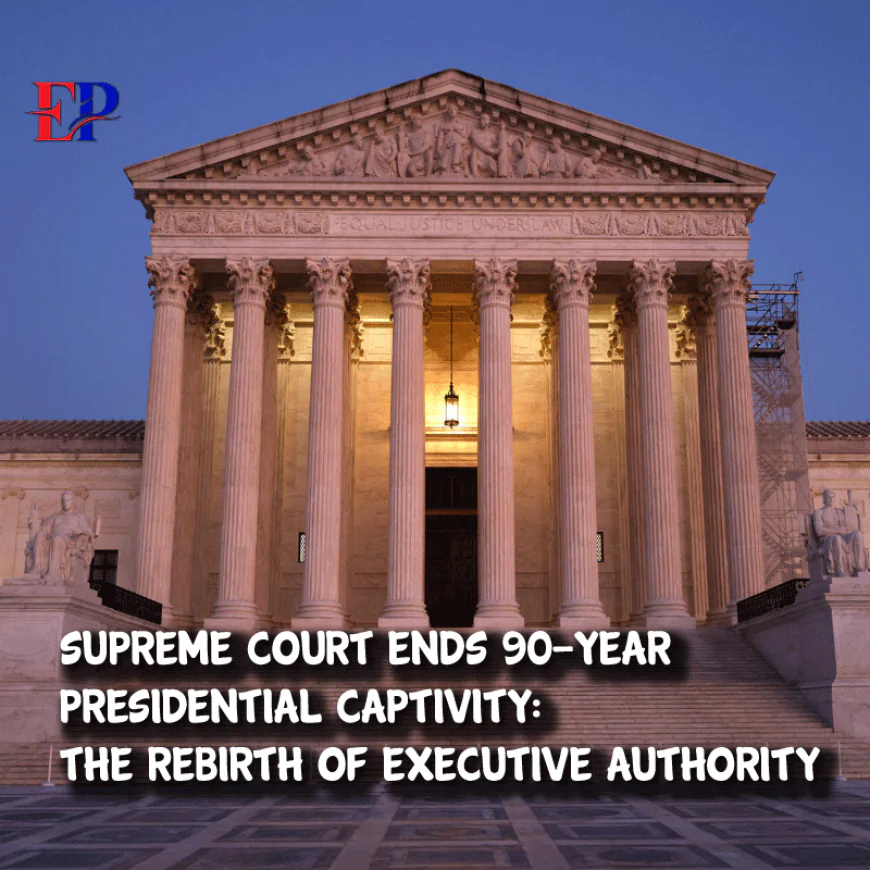
For almost a century, the United States President—the symbol of the nation’s executive power—was paradoxically shackled by a little-known but profoundly impactful Supreme Court ruling. Since 1935, the precedent set by Humphrey’s Executor v. United States has insulated federal "independent agencies"—such as the Federal Trade Commission (FTC), Securities and Exchange Commission (SEC), and Consumer Product Safety Commission (CPSC)—placing their commissioners beyond the President’s reach. The ruling, a product of the New Deal era’s complex battle between executive ambition and judicial restraint, created a legal fortress for bureaucrats, granting them lifetime security and effectively allowing them to operate without direct accountability to the elected President.
This institutional safeguard meant commissioners could neither be lawfully removed at will nor overruled by the Commander-in-Chief. For decades, these independent agencies functioned like autonomous mini-governments, crafting regulations wielded with the force of law, all without ever facing electoral consequences or presidential scrutiny. Essentially, the presidency had become a house where the President was a guest, not the master.
Yet, this era of executive subjugation has now come to a dramatic end. In a landmark 6-3 Supreme Court decision that few anticipated but everyone will remember, the Court affirmed the President’s exclusive constitutional authority to remove federal commissioners. President Donald Trump now holds undisputed power to dismiss figures such as Mary Boyle, Richard Trumka Jr., and Alexander Hoehn-Saric from the CPSC. The ruling explicitly reaffirmed that the executive power vested by the Constitution is indivisible and resides solely with the President—not independent agencies, bureaucratic boards, or unelected legal advisers.
This historic judgment strikes at the heart of what critics have long called the “administrative state” — a sprawling bureaucracy entrenched beyond democratic control. Nearly 700 key federal posts, across agencies like the FTC, SEC, National Labor Relations Board (NLRB), CDC, FDA, and DOE, stand vulnerable to renewed executive supervision. The decision dismantles the foundation of bureaucratic immunity and ends the hidden coup that began ninety years ago, restoring presidential supremacy within the federal government.
Inside the corridors of power, the ruling has sent shockwaves through the so-called Deep State — a collection of career officials who for decades circumvented electoral mandates by embedding themselves in protected positions. They thrived by rewriting regulations under the guise of "independent" authority, shaping policy without accountability, and shielding themselves under legal protections that barred their removal except for cause. Now, those protections have been stripped away, rendering the Deep State’s invisible empire exposed and vulnerable for the first time in nearly a century.
The Court’s decision is far more than a personnel matter. It is a restoration of constitutional order and democratic accountability. The unaccountable, unelected bureaucratic regime no longer outranks the President, the nation’s sole executive authority under Article II of the Constitution. This ruling breaks the legal scaffolding that has protected the administrative state’s usurpation of power, piece by piece.
Media silence on the ruling speaks volumes. The consequences for American governance are profound—if President Trump asserts this authority fully, the administrative state could face a comprehensive purge. Ideological mandates will be dismantled, political infiltrators removed, and federal agencies repurposed to serve the public, not partisan agendas. This moment marks the beginning of The Great Reclamation, when executive power is finally freed from nine decades of bureaucratic captivity.
President Trump’s second term begins not with limitation but with unprecedented authority. The presidency is no longer a gilded cage but a command post poised to purge, rebuild, and restore government to the people. The Deep State may have buried executive power in red tape and called it democracy, but the chains are broken, and the axe is in the President’s hands.
These links provide full opinions, detailed explanations, historical context, and legal analysis that can be very useful for your research, readers, and fact-checking needs.
-
Wikipedia summary and background of Humphrey's Executor:
https://en.wikipedia.org/wiki/Humphrey's_Executor_v._United_States -
Full Supreme Court opinion on Justia:
https://supreme.justia.com/cases/federal/us/295/602/ -
Official Supreme Court case page on Oyez:
https://www.oyez.org/cases/1900-1940/295us602 -
Ballotpedia overview of the case:
https://ballotpedia.org/Humphrey's_Executor_v._United_States -
PDF of the original Supreme Court opinion (US Library of Congress):
https://tile.loc.gov/storage-services/service/ll/usrep/usrep295/usrep295602/usrep295602.pdf -
Legal text version on Cornell Law School’s Legal Information Institute:
https://www.law.cornell.edu/supremecourt/text/295/602 -
Teaching American History doc on Humphrey’s Executor:
https://teachingamericanhistory.org/document/humphreys-executor-v-united-states/
What's Your Reaction?
 Like
0
Like
0
 Dislike
0
Dislike
0
 Love
0
Love
0
 Funny
0
Funny
0
 Wow
0
Wow
0
 Sad
0
Sad
0
 Angry
0
Angry
0









Comments (0)