

NASA Overhauled Artemis Moon Program Targeting Two 2028 Lunar Landings
NASA Administrator Jared Isaacman announced a sweeping Artemis overhaul Friday, adding missions, scrapping a Boeing upper stage, and targeting two separate lunar landings in 2028.
Key Takeaways
- NASA Administrator Jared Isaacman announced a sweeping Artemis overhaul Friday, adding missions, scrapping a Boeing upper stage, and targeting two separate lunar landings in 2028.
- NASA Revamps Artemis Moon Program With New Mission Lineup and 2028 Landing TargetNASA is starting over — at least in part. Administrator Jared Isaacman announced a sweeping over...
- Published: Mar 02, 2026 — Science

NASA Revamps Artemis Moon Program With New Mission Lineup and 2028 Landing Target
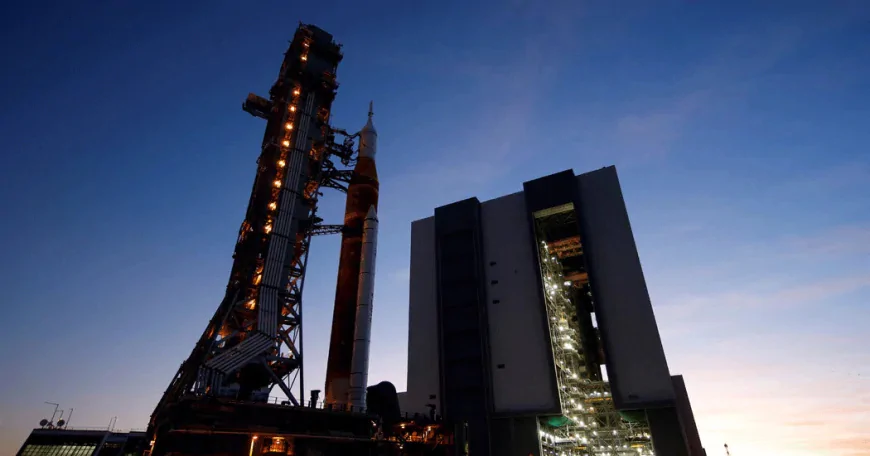
NASA is starting over — at least in part. Administrator Jared Isaacman announced a sweeping overhaul of the agency's Artemis moon program Friday, February 27, 2026, acknowledging that the existing plan could not safely achieve a lunar landing without an additional preparatory mission first. The restructured program targets not one but two crewed lunar landings in 2028 and scraps a Boeing-designed upper stage in favor of a leaner, faster approach modeled on the Apollo program's rapid-fire launch cadence.
"Everybody agrees this is the only way forward," Isaacman said Friday at a NASA news briefing at Kennedy Space Center in Cape Canaveral, Florida. "I know this is how NASA changed the world, and this is how NASA is going to do it again." The announcement came just two days after NASA's massive Space Launch System rocket was rolled back from Launch Pad 39B to the Vehicle Assembly Building for repairs after engineers discovered a blockage in the flow of helium to the upper stage booster.
The Artemis II mission — a lunar flyaround by four astronauts that has faced serial delays — is now pushed to no earlier than April 2026. It marks the latest in a string of setbacks that have made Artemis a recurring target of criticism from a safety review panel that warned the agency earlier this month to scale back its "overly ambitious" goals.
Artemis III Redesigned as Practice Mission, Not Landing
The most significant change in Isaacman's restructuring is the redesignation of Artemis III. The mission, which had been scheduled to attempt the first crewed lunar landing since Apollo 17 in 1972, will instead launch by mid-2027 and conduct technology demonstration flights in low-Earth orbit — specifically rendezvous and docking tests with one or both commercially built lunar landers from SpaceX and Blue Origin.
The rationale is straightforward. NASA's safety review board warned explicitly that attempting a full lunar landing without prior in-orbit docking tests between the Orion capsule and the lunar landers would carry unacceptably high risk. Isaacman accepted that recommendation. "We've got to get back to basics," he said, a phrase that became the headline of the briefing.
With a successful Artemis III in-orbit docking mission completed, NASA plans to attempt two separate lunar landings in 2028 — Artemis IV and Artemis V — using SpaceX's Starship lunar lander and Blue Origin's Blue Moon lander respectively. Annual moonshots are planned from 2029 onward, pending budget approval from Congress.
Boeing Upper Stage Scrapped in Cost and Simplification Drive
A secondary but significant element of the overhaul is the decision to drop the Boeing-built Exploration Upper Stage — a powerful second stage designed to increase the SLS rocket's payload capacity for future deep-space missions. The decision reflects both budget pressures and the administration's preference for leaner, faster hardware development timelines.
According to Casey Dreier, Chief of Space Policy at the Planetary Society, "The Artemis program has been its own worst enemy for years — overpromising, underdelivering, and watching its political coalition erode. Isaacman's restructuring is the most honest assessment NASA leadership has offered in a long time, and that honesty may be its best chance at actually getting back to the moon."
With China targeting its own crewed lunar landing by 2030 and its uncrewed Chang'e 7 mission set to explore the moon's south pole in 2026, the strategic pressure on NASA to execute cleanly — and quickly — has never been higher, making every delay in the Artemis timeline a win for Beijing's competing ambitions in cislunar space.
What's Your Reaction?
 Like
0
 Dislike
0
 Love
0
 Funny
0
 Wow
0
 Sad
0
 Angry
0













Comments (0)