

Blood Moon Total Lunar Eclipse Captivates North America, Asia and the Pacific
The March 3, 2026 total lunar eclipse turned the Moon deep red over North America, Asia, Australia and New Zealand in one of the most-watched celestial events of the year.
Key Takeaways
- The March 3, 2026 total lunar eclipse turned the Moon deep red over North America, Asia, Australia and New Zealand in one of the most-watched celestial events of the year.
- Blood Moon Turns Skies Red Over Half the Planet as Total Eclipse PeaksThe Moon turned a deep, rusty red above cities from Los Angeles to Manila to Auckland on Tuesday as the Mar...
- Published: Mar 03, 2026 — Science

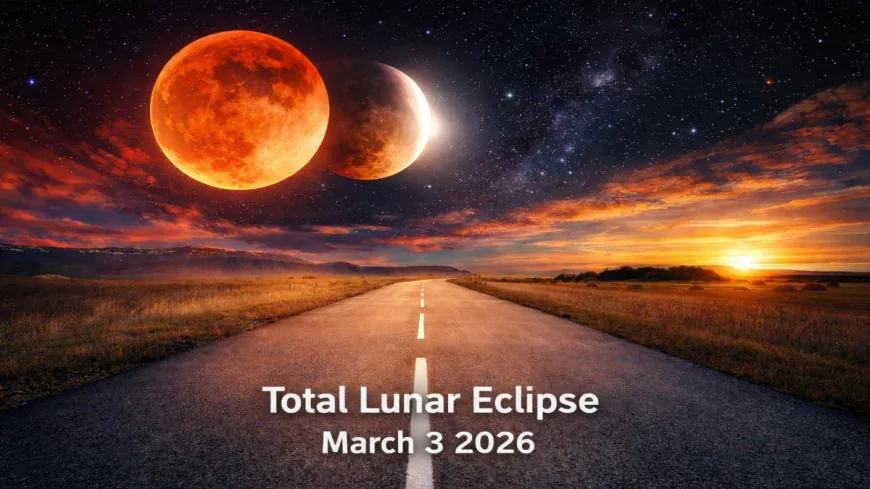
Blood Moon Turns Skies Red Over Half the Planet as Total Eclipse Peaks
The Moon turned a deep, rusty red above cities from Los Angeles to Manila to Auckland on Tuesday as the March 3, 2026 total lunar eclipse reached its peak totality in one of the most widely-watched astronomical events of the year. The phenomenon — popularly called a blood moon — occurred when Earth passed directly between the Sun and the Moon, casting its shadow fully across the lunar surface. Sunlight refracted by Earth's thick atmosphere filtered through, bending toward the red end of the spectrum and painting the Moon in colours ranging from deep copper to vivid rust across nearly five hours of partial and total coverage.
The eclipse was visible across North America, East Asia, Australia and New Zealand, but could not be seen from the United Kingdom, continental Europe or Africa. In the United States, Los Angeles provided one of the best viewing conditions of any major city, with clear skies offering an unobstructed view of the Moon's full transformation. Photographers across Canada, the U.S. West Coast, Japan, the Philippines and New Zealand captured striking images of the blood moon rising over city skylines, mountains and ocean coastlines.
Space.com confirmed Tuesday morning that the next blood moon visible over North America would not occur until New Year's Eve, 2028 — making Tuesday night's eclipse a once-in-nearly-three-years event for millions of observers in the western hemisphere.
Manila, Auckland and Havana Offered Prime Vantage Points
Some of the most dramatic photography from the eclipse emerged from the Philippines, where the blood moon rose above Manila's dense urban skyline against a clear tropical night. In Auckland, New Zealand, the blood moon appeared to float above the city's harbour, with observers describing the deep rust hue as more intense than in previous eclipses. Havana, Cuba, also produced striking imagery as the fully eclipsed Moon hung above the city's historic architecture.
In Toronto, Canada, observers gathered at waterfront locations along Lake Ontario to watch the Moon descend in totality as dawn approached. Amateur astronomers in multiple cities reported that the depth of the red colour — which varies based on the quantity of atmospheric aerosols in Earth's atmosphere at the time of the eclipse — was particularly vivid Tuesday, a quality attributed in part to ongoing volcanic activity that has slightly elevated global aerosol levels in recent months.
BBC Sky at Night Magazine invited observers to submit photographs from the eclipse, describing it as "one of the most highly-anticipated celestial events of the year." Images submitted by readers from across the Pacific region showed a diversity of viewing contexts, from mountaintop observatories to city rooftop terraces.
Timing Provided Rare Moment of Wonder Amid Global Tensions
For many observers, the eclipse offered something rarer than the astronomical event itself: a collective moment of shared wonder at a time when global news feeds were dominated by war, economic disruption and uncertainty. Social media platforms showed millions of users across very different political contexts all looking up at the same sky.
Astronomy educators noted that total lunar eclipses are not especially rare — they occur roughly twice a year on average globally — but the combination of geographic coverage, clear weather conditions, and the deep colour of Tuesday's totality made this particular event exceptional in its photographic record.
According to Dr. Rhonda Moore, astronomy outreach director at the University of Auckland, "A blood moon triggers something visceral and universal in human perception — it's the same sky everyone shares, regardless of what's happening below it, and events like this remind us of that."
The next significant lunar event visible globally will be a penumbral lunar eclipse in July. For North American observers, the long wait until New Year's Eve 2028 for the next blood moon begins tonight.
What's Your Reaction?
 Like
0
Like
0
 Dislike
0
Dislike
0
 Love
0
Love
0
 Funny
0
Funny
0
 Wow
0
Wow
0
 Sad
0
Sad
0
 Angry
0
Angry
0








Comments (0)