

Strait of Hormuz Formally Closed by IRGC, Sending Global Oil Markets Into Crisis
Iran's Islamic Revolutionary Guard Corps formally declared the Strait of Hormuz closed overnight, grounding at least 150 ships and sending Brent crude toward $85–$90 per barrel.
Key Takeaways
- Iran's Islamic Revolutionary Guard Corps formally declared the Strait of Hormuz closed overnight, grounding at least 150 ships and sending Brent crude toward $85–$90 per barrel.
- Iran Shuts Strait of Hormuz, Triggering Global Energy EmergencyIran's Islamic Revolutionary Guard Corps formally declared the Strait of Hormuz closed to commercial shipping in a...
- Published: Mar 03, 2026 — Business

Iran Shuts Strait of Hormuz, Triggering Global Energy Emergency
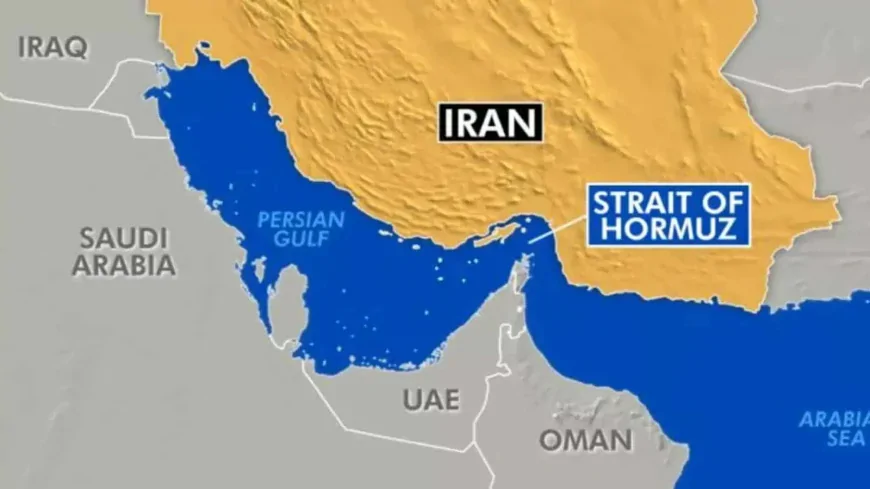
Iran's Islamic Revolutionary Guard Corps formally declared the Strait of Hormuz closed to commercial shipping in a statement issued overnight Tuesday, marking an extraordinary escalation with direct consequences for every energy-importing nation on earth. The narrow waterway, through which roughly 20 percent of the world's seaborne oil flows, became a declared conflict zone after IRGC commanders announced that any vessel attempting to transit would face military action. At least 150 ships anchored outside the strait's entrance, and five tankers were reported damaged in incidents linked to the closure, according to shipping intelligence sources.
Brent crude futures were forecast to gap toward $85 to $90 per barrel when Asian markets opened Tuesday — up from $77.74 at Monday's close, which itself represented a 6.68 percent single-session spike. Gold, which closed Monday at $5,338 per troy ounce, was expected to test $5,400 as investors accelerated their flight to safe-haven assets. J.P. Morgan analysts, who had already raised their year-end gold price target to $6,300, noted in a research update that "conflict-driven surges in gold come and go, though geopolitical risks broadly are likely to stay on the boil."
Major shipping lines — Maersk, Hapag-Lloyd, CMA CGM and MSC — all suspended Hormuz transits by Tuesday morning, with no stated timeline for resumption. The move effectively isolated a significant portion of Gulf energy exports from global markets at precisely the moment when OPEC+ had agreed to raise output by only 206,000 barrels per day in April, well below the 411,000 to 548,000 previously discussed.
Economic Shockwaves Reach Europe and Asia
The closure of major Gulf aviation hubs — Dubai, Abu Dhabi and Doha — compounded the energy supply disruption with a full-scale logistical crisis. Europe's aviation safety agency EASA imposed a conflict zone ban across 11 Middle Eastern countries, cancelling more than 1,300 flights on Tuesday alone. Lufthansa, Air France, KLM and British Airways all suspended Middle East operations. An estimated 300,000 British nationals were stranded in Gulf states, prompting the UK Foreign Secretary to activate consular evacuation support. Approximately 30,000 German tourists were similarly stranded on cruise ships and in hotels across the UAE and Qatar.
For European carriers already barred from Russian airspace since 2022, the Middle East closure eliminated the last efficient routing corridor to Asia. Airlines are now forced to fly either north via the Caucasus and Afghanistan or south via Egypt and Oman, adding hours of flight time and additional fuel consumption at the worst possible moment for operating margins.
TTF natural gas futures surged more than 60 percent in two days as traders priced in the possibility of disrupted liquefied natural gas shipments from Qatar. Asian energy importers, particularly India, faced compound pressure: a widening current account deficit combined with surging crude import costs.
Brazil, Chile, and South Africa Feel the Inflationary Knock-On
Emerging market economies are absorbing the oil shock with limited policy room. Brazil's Ibovespa opened almost 1 percent lower before staging a recovery driven almost entirely by Petrobras, which surged 4.58 percent as the state oil company positioned to benefit from higher crude prices. Chile's economic activity contracted 0.1 percent year-on-year in January — the first outright contraction in months — and the Hormuz crisis adds a significant cost-of-living headwind to an economy already struggling with slowing copper demand. South Africa's manufacturing PMI deteriorated further, with analysts citing energy cost inflation as a key driver.
According to Adam Crisafulli, founder of Vital Knowledge, "While the U.S. and Israeli militaries have complete dominance in the air, they cannot intercept every cheap Iranian drone — especially as interceptor stockpiles deplete."
The binary nature of the economic scenario is stark. If the Hormuz closure resolves quickly, markets will reverse sharply. If it persists for weeks, the oil-inflation-recession feedback loop that Wall Street is just beginning to model becomes the dominant macro story of 2026 — and perhaps beyond.
What's Your Reaction?
 Like
0
Like
0
 Dislike
0
Dislike
0
 Love
0
Love
0
 Funny
0
Funny
0
 Wow
0
Wow
0
 Sad
0
Sad
0
 Angry
0
Angry
0











Comments (0)