

Stock Markets Fall Worldwide as Iran War Triggers Global Recession Fears
Stock futures tumbled globally as investors fled equities for gold and safe-haven assets, adding the Iran conflict to a growing list of concerns already weighing on world financial markets.
Key Takeaways
- Stock futures tumbled globally as investors fled equities for gold and safe-haven assets, adding the Iran conflict to a growing list of concerns already weighing on world financial markets.
- Global Markets Reel as Iran War Stacks Up Against Existing Economic PressuresWall Street went into damage control mode before Monday's opening bell. Futures on the Dow Jones Ind...
- Published: Mar 02, 2026 — Business

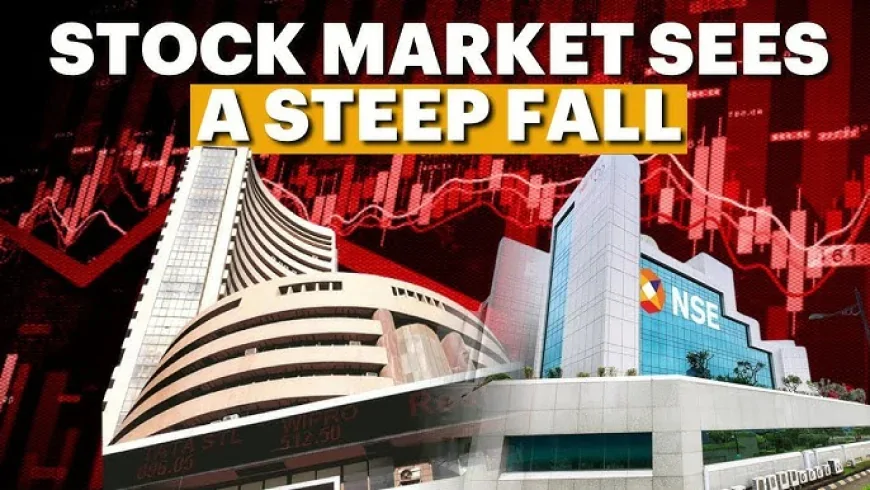
Global Markets Reel as Iran War Stacks Up Against Existing Economic Pressures
Wall Street went into damage control mode before Monday's opening bell. Futures on the Dow Jones Industrial Average dropped 517 points on Sunday evening. S&P 500 futures fell 1%. Nasdaq 100 futures declined more than 1%. Gold futures jumped 2% as investors sought safety in the oldest refuge available.
The sell-off arrived on top of an already fragile market backdrop. The US Supreme Court ruled last month that Trump did not have the authority to issue sweeping tariffs under a federal emergency powers law. That ruling removed a significant trade-policy overhang — but the Iran conflict has replaced it with something far harder to hedge.
Pakistan's benchmark KSE-100 Index collapsed 10% on Monday alone. European markets opened lower across the board. Oil majors gained — Exxon Mobil rose 4.1% in pre-market trading, Chevron climbed 3.9%, Shell advanced 2.2% in London — but those gains were swamped by losses everywhere else.
Three Simultaneous Shocks Battering Markets
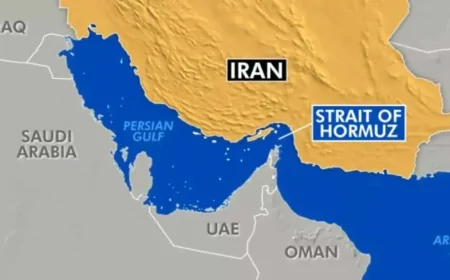
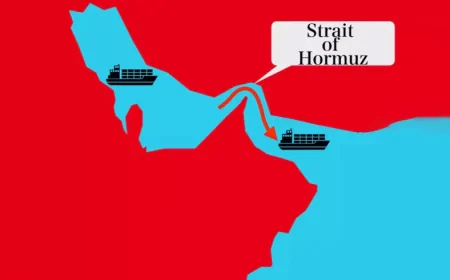
Analysts identified three intersecting pressures driving the sell-off. First, the Strait of Hormuz shutdown is threatening to deliver an energy price shock at a moment when inflation had only recently been brought under control in major economies. Second, the potential for the conflict to spread to other Gulf oil-producing countries carries a risk premium that no equity market can price with confidence. Third, the US political situation — with no clear end date for military operations and a president who has not delivered a formal public address — is generating deep uncertainty about decision-making at the highest level.
Gold's 2% jump reflected the flight to safety clearly. Long-dated US Treasury yields fell as bond buyers moved in. The dollar firmed against emerging market currencies. The euro dropped against the dollar as European markets absorbed the news that British military bases in the Middle East were now actively being used to intercept Iranian missiles.
Energy Companies Diverge Sharply From Broad Market
The split between energy and everything else was stark. France's TotalEnergies rose 3.6% in Paris. BP gained 1.8% in London. Halliburton and Schlumberger opened higher in New York. But airlines plunged — suspended flight operations across the Persian Gulf meant stranded passengers and no revenue on major routes. Hundreds of thousands of travelers were stranded in the region as dozens of airlines halted Middle East operations.
Banks fell sharply on concerns about exposure to Middle East debt markets and sovereign bonds from countries caught inside the conflict zone. Insurance companies face massive potential liability from maritime claims already piling up after three tanker strikes.
According to Michael Hartnett, Chief Investment Strategist at Bank of America Securities, "The market had already priced in a range of bad outcomes on trade and policy. What it had not priced in was a full-scale regional war with direct US military involvement. That is the variable that changes every calculation."
Historical Precedent and the Path Forward
Markets have historically recovered from Middle East oil shocks — but the speed of recovery depends almost entirely on how quickly the supply disruption ends. The 1973 Arab oil embargo took months to resolve and produced the worst stagflation crisis of the postwar era. The 1991 Gulf War shock was short-lived. The crucial variable, as analysts agree, is the Strait of Hormuz.
US midterm elections in November are now a live factor in financial planning. A prolonged energy price surge heading into the summer driving season would land squarely in the lap of Republican candidates defending the administration's decision to launch the strikes. Whether that political pressure produces a de-escalation push from Washington — or hardens Trump's resolve to see the operation through — is the question that will determine whether Monday's losses are a temporary shock or the opening chapter of something much worse.
What's Your Reaction?
 Like
0
Like
0
 Dislike
0
Dislike
0
 Love
0
Love
0
 Funny
0
Funny
0
 Wow
0
Wow
0
 Sad
0
Sad
0
 Angry
0
Angry
0








Comments (0)