

US Sanctions Rwandan Army for Backing M23 Rebels in DR Congo
The United States imposed sanctions on Rwanda's military and named commanders for their support of the M23 rebel group in DR Congo, marking Washington's sharpest rebuke of Kigali.
Key Takeaways
- The United States imposed sanctions on Rwanda's military and named commanders for their support of the M23 rebel group in DR Congo, marking Washington's sharpest rebuke of Kigali.
- US Sanctions Rwanda's Military for Congo Rebel Support in Sharpest Kigali Rebuke The United States imposed targeted sanctions on Rwanda's military command and named individual R...
- Published: Mar 05, 2026 — World News

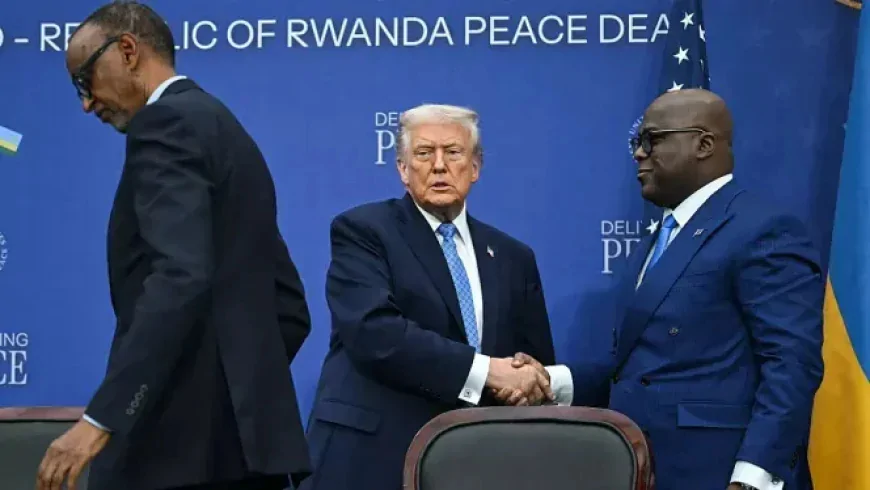
US Sanctions Rwanda's Military for Congo Rebel Support in Sharpest Kigali Rebuke
The United States imposed targeted sanctions on Rwanda's military command and named individual Rwandan Defence Force commanders for their role in supporting the M23 rebel group's operations in eastern Democratic Republic of Congo, the State Department announced this week. The move marks the sharpest direct rebuke of the government of President Paul Kagame by an American administration in more than a decade — and it comes at a moment when M23, backed by Rwandan military support and an estimated 3,500 to 4,000 Rwandan soldiers operating alongside them, has seized significant territory in the Kivu provinces.
The sanctions freeze US-held assets of the designated Rwandan military officials and prohibit American individuals and entities from conducting transactions with them. The designations do not constitute blanket sanctions on Rwanda as a state — US-Rwandan economic and diplomatic relations remain formally intact. But the symbolic weight of naming specific Rwandan commanders is substantial. Rwanda has consistently denied that its forces operate in eastern Congo, a position contradicted by UN reports, satellite imagery analysis, and testimony from multiple independent investigators.
The State Department statement cited evidence of M23 attacks on civilian populations, mass displacements, and atrocities including summary executions and sexual violence against civilians — violations documented by UN investigators and the Congo Human Rights and Environment Network. The US also referenced the seizure by M23 forces of the city of Goma — eastern Congo's largest city — in January 2025, a development that was described at the time as a catastrophic failure of international deterrence.
The Congo Conflict's Long History and Rwanda's Role
The M23 conflict has roots in the unresolved politics of the 1994 Rwandan genocide and its aftermath, when Hutu extremist perpetrators fled into eastern Congo and established armed groups that have disrupted regional stability for three decades. Rwanda has consistently framed its military engagement in eastern Congo — denied officially, documented extensively — as a security imperative driven by the presence of the Democratic Forces for the Liberation of Rwanda, the armed group descended from the génocidaires.
That framing has provided diplomatic cover for decades. Western governments, reluctant to confront Rwanda's government given the complexity of the genocide legacy and Kagame's track record of economic development and state-building, have been slow to impose costs on Kigali for actions that UN experts have documented in detail since 2022. The Biden administration declined to sanction Rwanda. The Trump administration's decision to do so represents either a genuine shift in US policy or a tactical response to pressure from human rights advocates and African Union member states — or both.
According to Dr. Jason Stearns, founder of the Congo Research Group at New York University, "The US sanctions are symbolically significant but practically limited. The designated commanders can route assets and transactions through non-US systems. What would actually change Rwandan behavior is a combination of multilateral pressure, targeted economic consequences that affect Rwanda's aid-dependent budget, and a credible regional peace process backed by the AU. The sanctions alone will not produce that."
DRC Politics, Regional Diplomacy, and the Peace Process
The sanctions come as a ceasefire negotiated in late 2025 under the auspices of the East African Community remains deeply fragile. M23 controls territory in North Kivu and South Kivu that it shows no indication of vacating. The DRC government of President Félix Tshisekedi has demanded Rwanda's withdrawal as a precondition for substantive negotiations — a demand that Kigali, which maintains formal deniability about its forces' presence, cannot meet without publicly acknowledging the extent of its military involvement.
Over 200 people were feared dead in a coltan mine landslide in eastern Congo this week, compounding a humanitarian situation already classified by the UN as one of the world's most severe. More than 7 million people are internally displaced in DRC — the largest displacement crisis in Africa and the third-largest in the world. The M23 offensive has added hundreds of thousands to that figure in the past twelve months alone.
Whether the US sanctions produce genuine pressure on Kagame's government or simply generate a diplomatic protest from Kigali — which has consistently framed international criticism of Rwanda's Congo policy as a failure to understand regional security realities — will determine whether the US action has lasting strategic significance or represents, as previous rounds of documentation and condemnation have, a cycle of naming without consequence. Congo has waited for thirty years for consequence. The question is whether 2026 is finally different.
The Pattern of Accountability and Why This Time May — or May Not — Be Different
The history of international responses to the DRC-Rwanda conflict is a history of documentation without consequence. The UN Group of Experts on the DRC has published detailed reports documenting Rwandan military support for M23 since the group's re-emergence in 2022. Previous reports named specific Rwandan military commanders. Previous reports documented weapons transfers, command structures, and logistical support chains. None of those reports produced US sanctions. The question that defenders of the current action must answer is why this time is different — and whether the difference is structural or situational.
The most plausible answer combines several factors. Rwanda's continued military operations after the January 2025 ceasefire agreement demonstrated that diplomatic engagement without consequences produces no change in behavior. The seizure of Goma — a major urban center — raised the stakes beyond what could be quietly managed. And the political context in Washington, where the Trump administration has pursued a more overtly punitive approach to governments it regards as acting against US interests, provided an opportunity for sanctions advocates inside the State Department who had been arguing for action for years.
For the DRC's 100 million people — and for the 7 million already displaced by conflict — what matters is not the legal analysis of the sanctions but whether they produce a change in the facts on the ground. M23 forces are currently occupying territory they have held for months. Rwandan soldiers are present in eastern Congo, officially denied, practically documented. Coltan, gold, and other minerals are being extracted from M23-controlled territory and exported through Rwandan commercial networks. None of that changes with Thursday's sanctions announcement. What changes, possibly, is the calculation in Kigali about the cost of continued non-compliance. Whether that recalculation produces genuine withdrawal or merely a tactical adjustment will become clear in weeks.
What's Your Reaction?
 Like
0
Like
0
 Dislike
0
Dislike
0
 Love
0
Love
0
 Funny
0
Funny
0
 Wow
0
Wow
0
 Sad
0
Sad
0
 Angry
0
Angry
0






Comments (0)