

House Republicans Kill Iran War Powers Curb, Hand Trump Victory
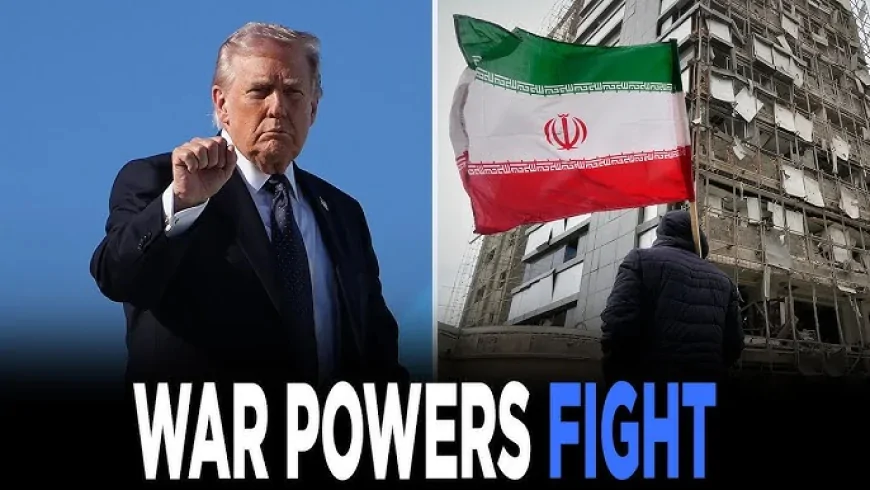
The US House voted down a war powers resolution seeking to limit Trump's authority to wage war on Iran, underscoring Republican loyalty to the White House.
Key Takeaways
- The US House voted down a war powers resolution seeking to limit Trump's authority to wage war on Iran, underscoring Republican loyalty to the White House.
- House Defeats War Powers Challenge, Cementing GOP Loyalty to Trump's Iran Campaign The United States House of Representatives voted Thursday to defeat a war powers resolution th...
- Published: Mar 05, 2026 — U.S. News

House Defeats War Powers Challenge, Cementing GOP Loyalty to Trump's Iran Campaign
The United States House of Representatives voted Thursday to defeat a war powers resolution that would have required congressional authorization for the continued prosecution of the US military campaign against Iran. The vote was the seventh time Congress has weighed such a measure since the US-Israeli strikes on Tehran began February 28. Every previous attempt has also failed.
The margin was 217 to 209. Not a single Republican voted in favor. Seven Democrats crossed the aisle to oppose the measure alongside the GOP majority. The outcome was expected but still striking: a legislature constitutionally vested with the power to declare war has now, repeatedly and deliberately, declined to exercise that power.
The resolution was introduced by Representative Ro Khanna of California and co-sponsored by 34 Democrats. It invoked the 1973 War Powers Resolution, which gives Congress the authority to terminate military operations not authorized by a formal declaration of war after 60 days — and immediately if the president lacks explicit congressional approval. The administration has not sought such approval.
The Constitutional Argument the GOP Chose to Ignore
The administration's legal position, articulated by White House Counsel David Warrington in a memo released Wednesday, is that the president acted under his constitutional authority as commander in chief and under existing authorizations for the use of military force. Critics, including several constitutional law scholars who testified before the House Judiciary Committee last week, called that argument thin at best and legally indefensible at worst.
According to Professor Rebecca Ingber, professor of national security law at Boston University School of Law, "The executive branch has been stretching the legal authority for military action for decades, but what we are seeing now is categorically different. Strikes on a sovereign nation with the explicit stated goal of regime change have no legal basis under any existing AUMF. The House's refusal to check this is a historic abdication."
Republican leaders framed the vote differently. Speaker Mike Johnson told reporters the House had a "patriotic obligation" to support the troops already in combat and that undermining the mission would "send a dangerous signal to Iran and to our allies." Several GOP members who privately have expressed reservations about the legal basis of the war voted against the resolution on those grounds.
The vote was also shaped by raw political arithmetic. With Republicans holding only a slim majority, any defection risked defeat. Leadership made clear that a vote in favor of the resolution would be treated as a vote against the president — and against the party — in an election year. That framing proved effective.
What the Vote Means for Congressional War Authority
The broader consequence of Thursday's vote extends beyond the immediate Iran conflict. Each failed war powers challenge weakens the institutional muscle of congressional oversight over military action. Legal scholars have long warned that the legislature's repeated failure to assert its constitutional prerogatives creates a de facto shift of war-making authority to the executive branch — a shift that proves difficult to reverse regardless of which party holds the White House.
Seven previous administrations have relied on exactly this dynamic to conduct military operations without formal declarations of war, from Kosovo to Libya to Syria. The Trump administration's Iran campaign is simply the most expansive, the most openly stated in its regime-change objectives, and the first to involve the killing of a head of state — Iran's Supreme Leader Ayatollah Ali Khamenei — since the US targeted Saddam Hussein in 2003.
Democrats have now introduced war powers legislation seven times in six days. The symbolic significance of that record is not lost on them. Minority Leader Hakeem Jeffries told reporters after the vote that "history will judge this Congress for what it refused to do when it had the chance." Senate Democrats have pledged to bring a companion measure to the Senate floor next week. Its prospects there are equally bleak.
Whether the courts will step in where Congress has not remains the open question. The American Civil Liberties Union and the Center for Constitutional Rights filed a joint legal challenge to the operation's legality in the District Court for the District of Columbia on Tuesday. A hearing has been set for March 12. Whether a federal judge is willing to adjudicate the legality of an ongoing military operation — and whether any ruling could be enforced in time to matter — is deeply uncertain.
The Broader Constitutional Erosion and What It Means
Congress's failure to assert its war-making authority over the Iran campaign is part of a decades-long trend in which the legislative branch has ceded power over military action to the executive. The 1973 War Powers Resolution was passed after Vietnam specifically to reclaim some of that authority — but every president since Nixon has argued that the resolution is unconstitutional, and Congress has never sued to enforce it. The courts have consistently declined to adjudicate the question, treating it as a political matter to be resolved by the elected branches.
The result is a constitutional arrangement in which the president can wage war indefinitely without congressional approval as long as the congressional majority declines to challenge it. Thursday's vote confirmed that the current Republican majority will not serve as that check. Whether a future Congress — of either party — would do differently is an open question that will not be answered until there is a president of the opposite party and a majority willing to act.
The ACLU's legal challenge, filed Tuesday in the DC District Court, argues that the operation lacks constitutional and statutory authority. But the historical precedent for federal courts intervening to halt an ongoing military operation is essentially nonexistent. The practical check on executive war-making in the American system has always been Congress — and Congress, for the seventh time in six days, has chosen not to exercise it.
What's Your Reaction?
 Like
0
Like
0
 Dislike
0
Dislike
0
 Love
0
Love
0
 Funny
0
Funny
0
 Wow
0
Wow
0
 Sad
0
Sad
0
 Angry
0
Angry
0












Comments (0)