

Trump Ousts Noem, Taps Mullin to Lead DHS Amid Iran War
President Trump fired Homeland Security Secretary Kristi Noem and nominated Senator Markwayne Mullin as her replacement during the ongoing US-Iran war.
Key Takeaways
- President Trump fired Homeland Security Secretary Kristi Noem and nominated Senator Markwayne Mullin as her replacement during the ongoing US-Iran war.
- Trump Removes Noem From DHS in Abrupt Dismissal, Names Mullin as Replacement President Donald Trump moved to replace Homeland Security Secretary Kristi Noem on Thursday, announc...
- Published: Mar 05, 2026 — U.S. News

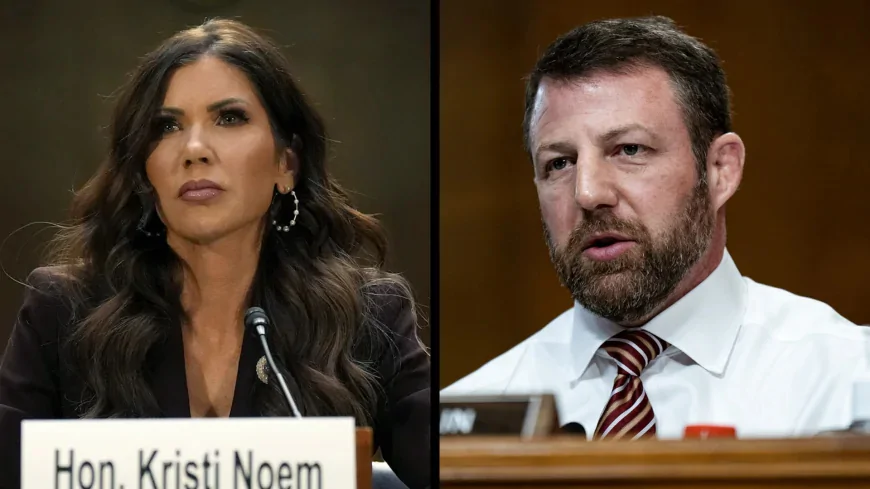
Trump Removes Noem From DHS in Abrupt Dismissal, Names Mullin as Replacement
President Donald Trump moved to replace Homeland Security Secretary Kristi Noem on Thursday, announcing on social media that he was nominating Oklahoma Republican Senator Markwayne Mullin in her place. The dismissal came without warning and at one of the most operationally demanding moments in the department's history — with the United States six days into a full-scale war against Iran and border and interior security operations running at peak intensity.
Trump offered no explanation in his announcement for Noem's departure. She did not immediately respond publicly. The White House declined to say whether she resigned or was fired.
Mullin, 47, a former mixed martial arts fighter turned politician, told reporters he received an unexpected call from Trump and was "excited to get started." He has no prior executive or national security experience in government. His confirmation will require Senate approval at a moment when the chamber is consumed by war-related legislation.
A Cabinet Shake-Up in the Middle of a War
The timing raises immediate questions about continuity at the department overseeing the country's borders, immigration enforcement, cybersecurity, and domestic counter-terrorism operations. DHS is simultaneously managing deportation operations across multiple states, tracking Iranian-linked threats to the US homeland, and coordinating with the intelligence community on potential retaliatory attacks on US soil — a threat senior officials have publicly described as elevated since the strikes on Iran began February 28.
Noem had been a visible and often controversial figure at DHS. Her Senate confirmation in early 2025 came after bruising hearings during which Democrats questioned her qualifications. She oversaw a dramatic expansion of ICE operations, the use of facial recognition and data surveillance tools to support deportations, and the rollout of emergency detention infrastructure. She was also the public face of what her critics called an unprecedented domestic surveillance apparatus targeting undocumented immigrants and the networks supporting them.
Whether her removal reflects dissatisfaction with her performance or internal White House dynamics remains unclear. Three former senior administration officials, speaking anonymously, told multiple news outlets that tensions between Noem and White House chief of staff Susie Wiles had been building for months over communication protocols and media strategy.
Mullin's Confirmation Path and the Political Stakes
Mullin's nomination triggers a political calculation that cuts in multiple directions. If he is confirmed and leaves the Senate, it triggers a special election in Oklahoma — a reliably Republican state, meaning the seat is unlikely to flip. But the process would temporarily reduce the Republican majority at a time when every vote in the Senate matters for war-related spending authorizations and the budget battle looming this spring.
According to Dr. Rachel Kleinfeld, Senior Fellow at the Carnegie Endowment for International Peace, "The confirmation of a new DHS secretary during an active external conflict is unprecedented in modern American history. The department's operational tempo right now is extraordinary, and installing an inexperienced leader mid-crisis adds institutional risk that the White House appears willing to accept for political reasons we can only speculate about."
Democrats wasted no time seizing on the move. Senate Minority Leader Chuck Schumer called it "reckless and destabilizing" and pledged that his caucus would scrutinize Mullin's nomination "with the seriousness this moment demands." Several moderate Republicans have privately expressed reservations, though none were willing to go on record.
Noem's record at DHS was not without critics within the administration itself. Her handling of a congressional hearing in March 2025, when she incorrectly described the constitutional protections afforded to migrants, prompted a quiet internal review. She had also been at the center of controversy over the DHS use of Palantir-built surveillance tools against asylum seekers and the broader immigrant community — a program that drew a federal court injunction in late 2025.
The removal adds to a broader pattern of turnover in Trump's second-term cabinet. Since January 2025, Trump has cycled through multiple senior appointees across departments, including two directors of national intelligence, two secretaries of defense, and now two DHS chiefs. Each departure has prompted fresh questions about institutional stability inside the administration overseeing the country's most sensitive national security infrastructure.
Mullin is expected to face his confirmation hearing within the next two weeks. The outcome will determine whether the country enters its first sustained Middle Eastern war in decades with an untested or a battle-hardened hand at the helm of domestic security. Whether Congress will slow-walk the nomination — or accelerate it in the name of wartime continuity — is the question hanging over Capitol Hill as the bombs continue to fall on Tehran.
The Broader Pattern of Trump's Second-Term Cabinet
Noem's dismissal fits a broader pattern in Trump's second term: cabinet secretaries who gain independent political profiles, generate unflattering media coverage, or are perceived to have built personal brands at the expense of administration loyalty tend not to last. Noem had become a fixture on conservative media and had made several public appearances that generated controversy, including a book tour that drew attention to her personal narrative in ways that distracted from administration messaging. Senior White House officials had grown weary of managing the fallout.
The appointment of Mullin, a former MMA fighter and construction business owner turned congressman turned senator, signals a preference for loyalty and personal chemistry over institutional expertise. Trump and Mullin are reported to have developed a close working relationship during the Senate tenure, including on immigration and border security votes. Mullin's willingness to take the job — giving up a Senate seat and the independence that comes with it — is itself a signal of the premium the administration places on unquestioned alignment.
What Noem's departure means for ongoing DHS operations — including the surveillance programs targeting immigrants, the detention facility expansion, and the Iran-threat domestic monitoring operations that have been underway since February 28 — will become clearer in the coming days as a caretaker secretary manages the department while the Senate confirmation process unfolds. Whether that transition is smooth or fractious may depend on how abrupt the internal handover proves to be.
What's Your Reaction?
 Like
0
Like
0
 Dislike
0
Dislike
0
 Love
0
Love
0
 Funny
0
Funny
0
 Wow
0
Wow
0
 Sad
0
Sad
0
 Angry
0
Angry
0









Comments (0)