





















Spain's Sanchez Defies Trump on Iran Bases, Faces US Trade Retaliation
Spanish PM Pedro Sanchez refused to allow US forces to use Spanish military bases for the Iran war, prompting Trump to threaten to cut all trade with Spain.
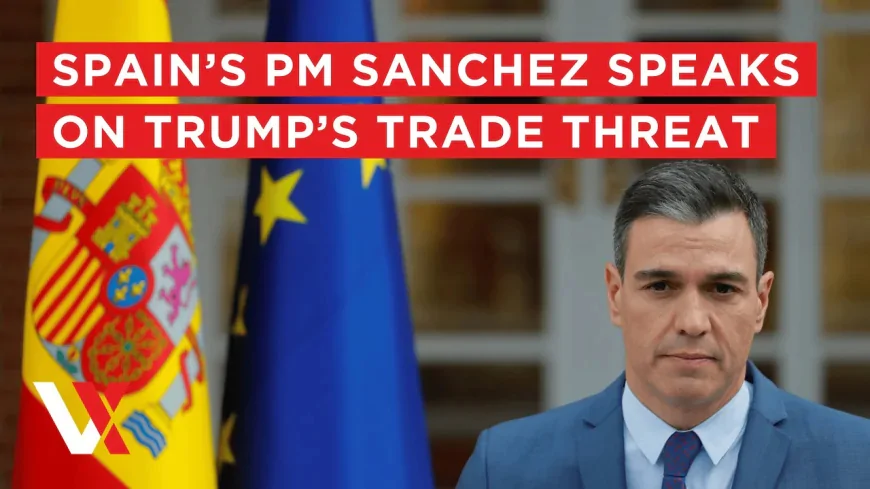
Sanchez Refuses US Iran War Bases in Blunt Break from European Deference
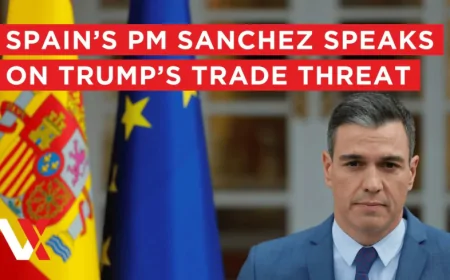
Spanish Prime Minister Pedro Sanchez publicly refused this week to allow the United States to use Spanish military installations for operations in the Iran war — a decision that drew immediate praise from Iranian President Masoud Pezeshkian and an immediate threat from US President Donald Trump to "cut off all trade with Spain." The standoff positions Spain as the most prominent European dissenter from the US-Israeli campaign and places Sanchez, already isolated within the European mainstream on Middle East policy, at the center of a transatlantic rupture with direct economic consequences for Madrid.
Iran commended Spain's stance. Pezeshkian named Sanchez directly in remarks carried by state media, calling him an example of a European leader who had not surrendered his country's sovereignty to American diktat. For a Spanish government that has been deepening commercial and diplomatic ties with the broader Arab world over the past two years, the Iranian praise — however unsolicited — creates its own political complications domestically.
Trump's trade threat was rapid and unambiguous. The president took to his social media platform within hours of the Spanish announcement to declare that Spain would "feel the consequences" of its refusal, adding that the US would consider all options including tariffs, investment restrictions, and the termination of preferential trade arrangements. Spain exports approximately €18 billion in goods annually to the United States — including automobiles, machinery, olive oil, and wine — making the US its third-largest trading partner.
The European Calculus: Support Without Complicity
Spain's refusal crystallizes a division within Europe that has widened since the strikes began. Most European governments have issued statements expressing concern about civilian casualties or calling for de-escalation without directly condemning the US-Israeli operation. The United Kingdom's Labour government under Prime Minister Keir Starmer has been the most explicitly supportive of European governments, stopping short of active military participation but permitting limited US use of British base infrastructure in Cyprus — a decision that generated significant parliamentary controversy in London.
Sanchez set himself apart from other European leaders in the directness of his refusal. The Spanish position is not ideologically neutral: Sanchez leads a minority government that depends on coalition partners, including left-wing parties deeply opposed to the Iran war on legal and humanitarian grounds. His refusal to grant base access reflects domestic political constraints as much as independent foreign policy conviction.
According to Dr. Pol Morillas, director of the Barcelona Centre for International Affairs (CIDOB), "Sanchez is the most exposed European leader on this question because he is the only one who has said no in terms that have consequential implications for the United States war effort. That puts Spain in a category apart — both in terms of its relationship with Washington and in terms of what it signals to the rest of the EU about the space for European dissent."
The Legal Dimension: International Law and the Use-of-Force Question
European legal scholars have lined up in significant numbers to challenge the legality of the US-Israeli operation. The European Council on Foreign Relations published an analysis last week describing the strikes as "an illegal war of choice" under international law and calling on European governments to say so publicly. The European Journal of International Law published a rapid-response analysis questioning the legality of the UK's decision to intercept Iranian missiles using British-operated systems in Cyprus and permit limited US operational use of British bases.
No formal European Union position has emerged. The bloc's foreign policy chief has issued a generic call for "all parties to exercise restraint" — language that satisfies no one and commits the EU to nothing. Hungary's government, under Prime Minister Viktor Orbán, has been the most vocal within EU institutions in opposing the military campaign, which creates an uncomfortable alignment for governments that have spent years trying to isolate Orbán as an outlier. Whether Sanchez's defiance will catalyze a more coherent European position on the legality and limits of the US campaign — or whether it will remain an isolated political gesture — is the test the coming days will force.
The EU's Inability to Speak With One Voice
Spain's defiance underscores the European Union's continuing inability to formulate a coherent foreign and security policy on matters where member states hold fundamentally divergent interests and strategic cultures. The EU has no formal position on the Iran war. Its foreign policy chief has issued statements that express concern without committing to any position. The silence reflects the political reality that any EU statement would require unanimity among 27 member states — including Hungary, which has expressed sympathy for the US operation, and Spain, which has explicitly opposed it.
The EU's powerlessness in this crisis is also a function of its structural dependency on American security guarantees. European defense spending, while increasing, remains far below the level required for autonomous strategic action. No European state has the independent military capability to affect the outcome of a major Middle Eastern military campaign. Their only levers are diplomatic and economic — and those levers require coordination and political will that the EU currently lacks.
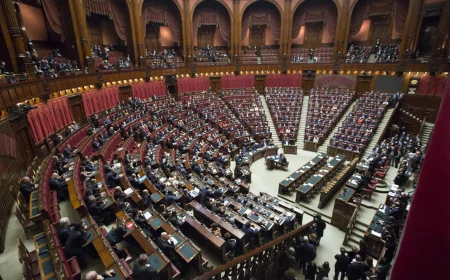
For Sanchez personally, the political calculation is more immediate. His coalition government depends on partners to his left who regard the Iran war as a moral catastrophe and who would withdraw support if he were seen to have capitulated to American pressure. His refusal to grant base access is, in that sense, as much about governing Spain as it is about international principle. Whether Trump's trade threat translates into actual economic consequences — and whether those consequences create political pressure from Spanish business interests that outweighs Sanchez's left-coalition math — will determine how long the standoff continues.