

China Sets Its Lowest GDP Target Since 1991 at NPC Opening Session
China's NPC opened Thursday with Premier Li Qiang announcing a GDP growth target of 4.5 to 5 percent, the lowest Chinese economic goal since 1991.
Key Takeaways
- China's NPC opened Thursday with Premier Li Qiang announcing a GDP growth target of 4.5 to 5 percent, the lowest Chinese economic goal since 1991.
- China's Lowest Growth Target in Three Decades Opens a Pivotal Political Moment for Xi China's National People's Congress opened its annual session in Beijing Thursday with Premi...
- Published: Mar 05, 2026 — China

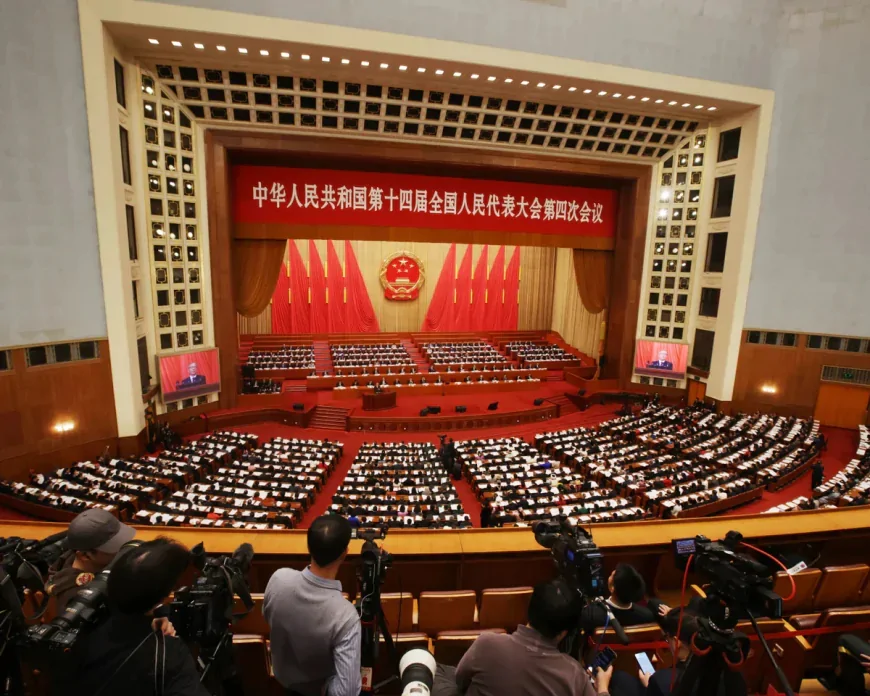
China's Lowest Growth Target in Three Decades Opens a Pivotal Political Moment for Xi
China's National People's Congress opened its annual session in Beijing Thursday with Premier Li Qiang delivering the most sobering economic assessment a Chinese premier has presented to the body in more than three decades. The growth target for 2026 — set at 4.5 percent to 5 percent — marks the first time since 1991 that Beijing has formally acknowledged, through the mechanism of a reduced GDP target, that the era of reliably high growth may be structurally constrained rather than temporarily interrupted.
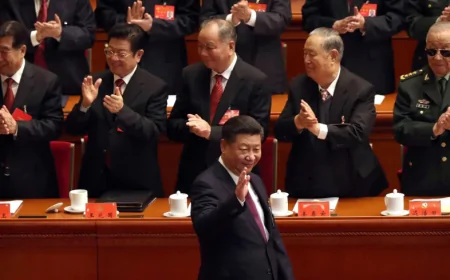
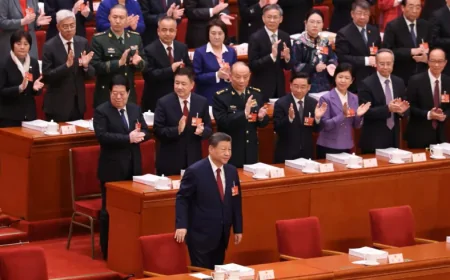
Li presented the Government Work Report to the nearly 3,000 delegates assembled in the Great Hall of the People, delivering much of the 35-page document in an address lasting more than an hour. President Xi Jinping was present in the front row, as he has been for every NPC opening in his tenure — a visible signal of the political stakes attached to the economic roadmap being ratified.
The lowered target compares to actual 5 percent growth achieved in 2025 and a stated target of "around 5 percent" in each of the preceding three years. Li's acknowledgment that China faces a "grave and complex landscape" in which "external shocks and challenges were intertwined with domestic difficulties and tough policy choices" represented a degree of official candour about structural economic challenges that is unusual for the carefully managed NPC communication environment.
The Five-Year Plan: Innovation Over Stimulus
Accompanying the GDP target, Li unveiled the outline of China's 15th Five-Year Plan — its development blueprint for 2026 through 2030 — which emphasises technological self-reliance, advanced manufacturing, and innovation rather than the infrastructure-led growth that drove China's rapid rise. The plan includes explicit goals around integrated circuits, aviation and aerospace, biomedicine, and what Li called the "low-altitude economy" — a reference to the expanding use of drone technology in logistics, agriculture, and emergency services.
For the first time, the Five-Year Plan includes a stated goal of "realizing a noticeable increase in consumption as a share of GDP," according to analysis by Louis Kuijs of S&P Global. That framing reflects Beijing's recognition that its most acute structural problem — insufficient domestic demand — cannot be solved by investment and export orientation alone. Yet the annual work report indicated that no major new stimulus would be deployed in the short term to accelerate the consumption shift.
According to Neil Thomas, China politics expert at the Asia Society Policy Institute, "Beijing continues to prioritise strengthening industrial self-reliance over boosting household consumption. The five-year plan signals where they want to be in 2030. The annual target tells you they don't believe they can get there faster."
Military Spending, Political Loyalty, and the Purged Delegates
In its draft budget for 2026, the government trimmed the annual increase in defence spending to 7 percent — marginally below the 7.2 percent increase of recent years — bringing total military expenditure to 1.9 trillion yuan, approximately $270 billion. The reduction is marginal; China remains on a sustained military modernisation trajectory regardless of the headline figure.
More significant than the headline spending number is a new line in the annual report that declared the government would "improve military political conduct" guided by the principle of "ensuring political loyalty in the military." The phrase is a direct response to the unprecedented purge of senior People's Liberation Army officers on corruption charges that has defined Xi Jinping's third term — a purge that has swept out commanders across the Rocket Force and strategic support structures. Nine military officers were among 19 NPC delegates dismissed from the congress ahead of this year's session.
The combination of a softened growth target, a structural economic reform agenda, a modestly trimmed but still expanding military budget, and an explicit reassertion of Party control over the armed forces paints the portrait of a leadership navigating multiple simultaneous pressures. Whether China can engineer the consumption-driven economic rebalancing its own leaders have identified as necessary — while maintaining political stability, military modernisation, and resistance to external trade pressures — is the defining political and economic question facing Beijing through 2030 and beyond.
The 15th Five-Year Plan and the Technology Nationalism at Its Core
The 15th Five-Year Plan, which will govern Chinese economic and social development targets from 2026 to 2030, represents the most explicitly technology-nationalist planning document in Chinese history. Previous five-year plans emphasised growth rates, urbanisation targets, and infrastructure investment. The 15th plan centres on overcoming what Chinese planners call "bottlenecks in critical core technologies" — a reference to the semiconductor, advanced materials, and precision manufacturing domains in which US export controls and allied supply chain restrictions have exposed Chinese industrial vulnerability.
The plan's emphasis on "high-quality development" over raw growth rates reflects a genuine strategic recalibration. Chinese planners have concluded that the era in which raw GDP growth could substitute for technological sophistication is over. The US-China technology competition, which has progressively restricted Chinese access to advanced semiconductors, EDA software, and AI chips, has forced Beijing to treat domestic technological self-sufficiency not as an aspirational goal but as an immediate industrial policy priority.
The domestic implications of this shift are significant. The technology-nationalism agenda requires concentrated capital allocation toward advanced industries, which means that consumption-led growth — the demand-side stimulus that economists say China needs — must compete for resources with supply-side industrial policy. Li Qiang's work report attempts to present both as compatible; independent economists are more sceptical that China can simultaneously sustain its industrial upgrade trajectory and execute the household income growth needed to rebalance the economy away from its investment and export model within a single five-year planning period.
What's Your Reaction?
 Like
0
Like
0
 Dislike
0
Dislike
0
 Love
0
Love
0
 Funny
0
Funny
0
 Wow
0
Wow
0
 Sad
0
Sad
0
 Angry
0
Angry
0













Comments (0)