

Crenshaw Ousted in Texas Primary as Talarico Claims Democratic Nom
Dan Crenshaw became the first incumbent to lose renomination in 2026 as Texas and North Carolina held their first midterm primaries, shaping November's battle.
Key Takeaways
- Dan Crenshaw became the first incumbent to lose renomination in 2026 as Texas and North Carolina held their first midterm primaries, shaping November's battle.
- Crenshaw Falls in Texas as 2026 Midterms Open With Incumbent Carnage Representative Dan Crenshaw, the decorated Navy SEAL turned Republican congressman from Texas, became the fi...
- Published: Mar 05, 2026 — U.S. News

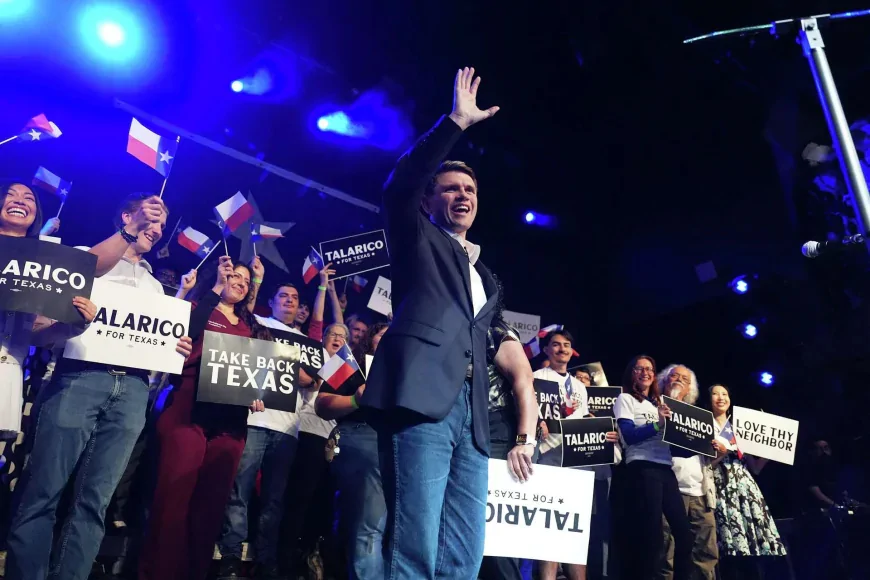
Crenshaw Falls in Texas as 2026 Midterms Open With Incumbent Carnage
Representative Dan Crenshaw, the decorated Navy SEAL turned Republican congressman from Texas, became the first sitting member of Congress to lose renomination in the 2026 midterm cycle on Tuesday, ousted by state Representative Steve Toth in a primary that centered on a single question: who is more loyal to Donald Trump. The answer, Texas Republican voters made clear, was not Crenshaw.
Toth, a hard-right state legislator from The Woodlands, ran on Crenshaw's perceived insufficiency of fealty to the MAGA movement. He attacked Crenshaw's past criticism of election denialism, his occasional departures from Trump orthodoxy on foreign policy, and his record of independent-minded statements. The strategy worked. Texas Republicans have moved decisively rightward since 2020, and Tuesday confirmed that the old coalition Crenshaw once relied on — military veterans, suburban moderates, and hawkish conservatives — has shrunk considerably.
In North Carolina, former Republican National Committee chair Michael Whatley secured his party's Senate nomination, while former Governor Roy Cooper won the Democratic slot. The two will face each other in November for what is expected to be one of the most expensive Senate races of the cycle.
The Talarico Factor: Democrats' Insurgent Future
On the Democratic side, state Representative James Talarico's defeat of US Representative Jasmine Crockett in the Texas Senate primary was the night's most-discussed result. The race had been framed nationally as a battle over the soul of the Democratic Party — Crockett representing the sharper-edged, nationally prominent approach, Talarico advocating what he has called a "politics of love," built on aggressive retail campaigning, non-traditional coalition building, and an explicit rejection of both centrism and performative outrage.
Talarico's victory was decisive — by more than 12 percentage points — in a primary that saw record turnout on the Democratic side. The turnout figures immediately generated intense analysis. Democrats in Texas mobilized in unexpectedly large numbers, driven in part by opposition to the Iran war, anger over the Trump administration's domestic policies, and the visceral energy of a competitive Senate race for the first time in years.
According to Dr. Victoria DeFrancesco Soto, dean of civic engagement at the LBJ School of Public Affairs at the University of Texas at Austin, "The Texas Democratic primary turnout should not be read as a map of November. But it is a genuine signal that there is an activated electorate on the left that was dormant in 2024. Talarico will now have to decide whether his 'politics of love' can survive contact with a general electorate in a state that hasn't sent a Democrat to the Senate in 30 years."
Senate Runoff in Texas and the Republican Civil War
The Texas Republican Senate primary delivered the most consequential result of the night for national politics. Senator John Cornyn and state Attorney General Ken Paxton advanced to a runoff after neither reached the 50 percent threshold required in Texas. Congressman Wesley Hunt was eliminated in third place. Trump, who had endorsed all three candidates at various points — a contradictory posture that drew bipartisan mockery — promised to endorse either Cornyn or Paxton and push the other to withdraw.
The runoff will be a proxy war for the direction of the Republican Party. Cornyn represents the establishment wing — institutionalist, hawkish, dealmaker. Paxton is a convicted felon who was acquitted of impeachment charges by the state Senate in 2023, a darling of the MAGA base who has made a political identity out of confrontation with federal authority and persecution narratives. Both men are now waiting for Trump to make the phone call that will likely determine the outcome.
In Arkansas, incumbent Senator Tom Cotton won his primary without difficulty, a result that generated little drama but reminded observers that the war in Iran is playing differently across Republican constituencies. Cotton, a long-standing Iran hawk who has advocated military action against Tehran for years, faces a general election in November in a state that is not competitive. His political trajectory will not be defined by Tuesday's results. Crenshaw's, by contrast, is now over. Texas sent the first member of Congress home in 2026. How many more the November cycle claims — and which party absorbs the greater losses — will depend partly on how long the war in Iran lasts, and partly on whether Donald Trump's grip on Republican primary voters holds through the autumn.
The Structural Significance of Texas Democratic Turnout
Democratic turnout in Tuesday's Texas primaries exceeded expectations by a margin that caught campaign strategists on both sides of the aisle by surprise. Preliminary figures show Democratic primary participation in several major counties at levels comparable to 2018 — the year Democrats came within three percentage points of winning a Texas Senate seat when Beto O'Rourke challenged Ted Cruz. That was supposed to be a once-in-a-generation mobilization. The 2026 figures suggest it may be something more structural.
What is driving that mobilization is a subject of debate. Some analysts point to opposition to the Iran war, arguing that the US military campaign has energized a demographic — young, college-educated, urban — that had grown disengaged since 2018. Others emphasize the Talarico campaign's organizational innovations: his campaign conducted canvassing in 200 Texas counties, including deeply conservative rural areas where no Democratic Senate candidate has invested in years. His volunteer army, built around direct human contact rather than digital advertising, produced turnout in places that Democratic strategists had written off as unreachable.
Whether any of this translates to November competitiveness in Texas depends on factors that no primary can answer. Texas Democrats have produced electoral surprises before and failed to follow them through. The structural advantage Republicans hold in the state — from its redistricted congressional map to its partisan state judiciary — is formidable. But if Talarico can run at anything close to his primary margin across the state in November, the race will be competitive in ways that Texas has not seen since 2018.
What's Your Reaction?
 Like
0
Like
0
 Dislike
0
Dislike
0
 Love
0
Love
0
 Funny
0
Funny
0
 Wow
0
Wow
0
 Sad
0
Sad
0
 Angry
0
Angry
0









Comments (0)