

China Purges Nine Military NPC Delegates in Anti-Corruption Drive
Nine Chinese military officers were among 19 NPC delegates dismissed before the 2026 session, as Xi Jinping deepens his anti-corruption purge of the PLA.
Key Takeaways
- Nine Chinese military officers were among 19 NPC delegates dismissed before the 2026 session, as Xi Jinping deepens his anti-corruption purge of the PLA.
- Xi's Military Purge Reaches NPC Chamber as Nine Officers Are Expelled Before Session Opens Nine military officers — among the most politically significant group of expelled dele...
- Published: Mar 05, 2026 — China

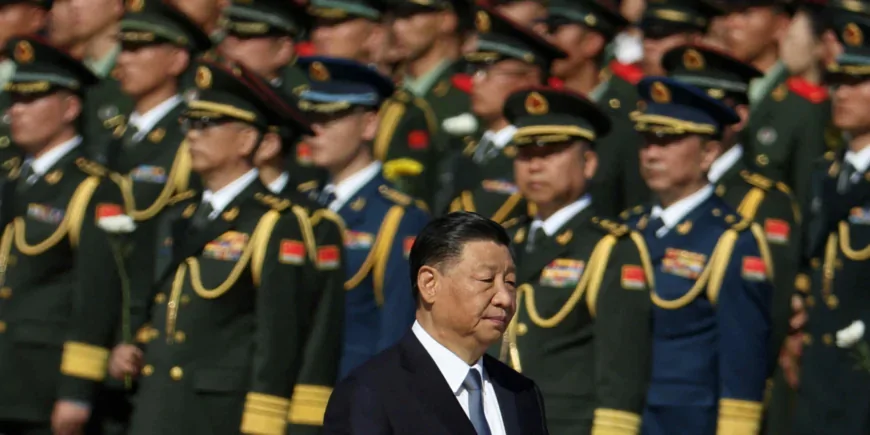
Xi's Military Purge Reaches NPC Chamber as Nine Officers Are Expelled Before Session Opens
Nine military officers — among the most politically significant group of expelled delegates in the history of the National People's Congress — were removed from the body before its 2026 session opened Thursday, part of a sweeping purge of People's Liberation Army leadership that has removed more senior commanders from office in the past three years than at any point since the Cultural Revolution. The dismissals, formalised in a pre-session announcement that drew limited domestic coverage due to censorship constraints, signal that Xi Jinping's campaign to reshape the military's culture of loyalty, discipline, and political reliability has not concluded.
The expelled officers join a growing roster of PLA generals and admirals who have been publicly dismissed, quietly placed under investigation, or simply disappeared from official proceedings in Xi's third term. The most visible cases have centred on the Rocket Force — China's nuclear and conventional missile command — where two consecutive commanders were removed in 2023 and 2024 amid investigations that touched on procurement fraud, false reporting, and allegations of compromised security relationships.
Western defence analysts have watched the purge with a mixture of strategic interest and genuine uncertainty. On one reading, the dismissals represent a genuine effort to reform a military institution corroded by decades of commercially corrupt flag-officer culture. On another, they represent Xi's use of anti-corruption mechanisms as an instrument of political control — a tool for ensuring that no single faction within the PLA builds sufficient institutional power to challenge his authority.
The ""Political Loyalty"" Clause: What It Signals About PLA Command Culture
The 2026 Government Work Report, presented by Premier Li Qiang to the full NPC assembly on Thursday, contained a new and notable addition to the standard language on military affairs. For the first time, the report declared that the government would "improve military political conduct" guided by "ensuring political loyalty in the military." The phrase represents a departure from the more anodyne formulations of previous years and encodes in official government language a concern that has driven the purge from its outset.
PLA officers in the Rocket Force and other strategic commands are required by their roles to manage equipment, intelligence, and operational planning of the highest sensitivity. Corruption at that level — the procurement of sub-standard components for missile systems, the falsification of readiness reports, the sale of classified information — does not merely waste public funds. It creates direct vulnerabilities in China's strategic deterrent that Xi and his national security apparatus regard as existentially serious.
According to Dr. Kristin Ven Bruusgaard, research director at the Norwegian Institute for Defence Studies and a specialist in Chinese strategic forces, "The language about 'political loyalty' in the work report is unusually direct for an official Chinese document. It suggests that Xi believes the corruption problem in the PLA had, at some points, a political dimension — not just financial misconduct but officers whose loyalties were contested. That is a remarkable thing for a government to say publicly about its own armed forces."
Defense Spending Adjusted, but the Trajectory Holds
China's defence budget for 2026 was set at approximately 1.9 trillion yuan — roughly $270 billion at current exchange rates — representing a 7 percent annual increase, slightly below the 7.2 percent of recent years. The reduction is cosmetically significant but strategically modest. China remains the world's second-largest military spender in absolute terms and continues to invest heavily in naval expansion, air force modernisation, space-based capabilities, and the cyberwarfare domain.
The trimming of the defence growth rate, coming alongside the lowered GDP target, reflects the same underlying fiscal constraint: a government managing a property sector crisis, weak domestic demand, and diminished tax revenues cannot indefinitely sustain the growth rates of its peak expansion era in every spending category simultaneously. The military modernisation programme has been explicitly protected — the 7 percent growth continues — but the signal that trade-offs are being made will be noted carefully in Taiwan, Tokyo, and Washington.
The combination of a purged NPC delegation, a new political loyalty mandate, and a sustained but marginally trimmed defence budget describes a Chinese military in the middle of a transformation it has not yet completed. Whether the officers who replace those expelled prove more capable, more loyal, or simply more cautious remains to be seen in the operational environment that, as of today, includes an active US-Israeli war in the Middle East and a deteriorating security architecture across East Asia.
The Political Loyalty Campaign: Rebuilding a Military Xi Can Trust
The phrase "political loyalty in the military" inserted into the 2026 Government Work Report is not the language of routine civil-military governance. It is a political signal of the highest significance, directed at every officer in the People's Liberation Army and every civilian official who interfaces with it. Xi Jinping's anti-corruption campaign in the military has produced the dismissal of more flag officers in a three-year period than at any point since the PLA's modern professionalisation began in the 1980s — and his public assertion that the campaign must continue suggests the process is not complete.
The political risk of the purge is not merely that it has disrupted operational chains of command and created uncertainty in strategic planning. It is that a military defined primarily by political loyalty rather than professional competence may make different decisions — and potentially worse ones — under conditions of actual crisis. Taiwan, as the most likely scenario in which PLA capabilities would be tested in a major conflict, represents the critical test case for whether Xi's rebuilt military performs as intended or reveals the hidden costs of a loyalty-first selection process.
US and allied intelligence services have tracked the PLA purge with intense interest precisely because its implications for Chinese military readiness are genuinely ambiguous. A military with fewer corrupt officers may be more effective. A military that has been through the institutional equivalent of multiple cardiac events in three years may be less so. The nine NPC delegates expelled before Thursday's session are the most recent public evidence of a process whose full scope and ultimate implications remain opaque to every external observer — including, potentially, to Xi Jinping himself.
What's Your Reaction?
 Like
0
Like
0
 Dislike
0
Dislike
0
 Love
0
Love
0
 Funny
0
Funny
0
 Wow
0
Wow
0
 Sad
0
Sad
0
 Angry
0
Angry
0






Comments (0)