

Russia Strikes Ukraine With 155 Drones as Iran War Freezes Peace Talks
Russia launched 155 drones against Ukraine as Zelensky confirmed that trilateral peace talks with the US are on hold due to the war against Tehran.
Key Takeaways
- Russia launched 155 drones against Ukraine as Zelensky confirmed that trilateral peace talks with the US are on hold due to the war against Tehran.
- 155-Drone Barrage Hits Ukraine as Washington's Attention Turns to Tehran Russian forces launched 155 drones against Ukrainian territory overnight, including approximately 100 Sh...
- Published: Mar 05, 2026 — Russia

155-Drone Barrage Hits Ukraine as Washington's Attention Turns to Tehran
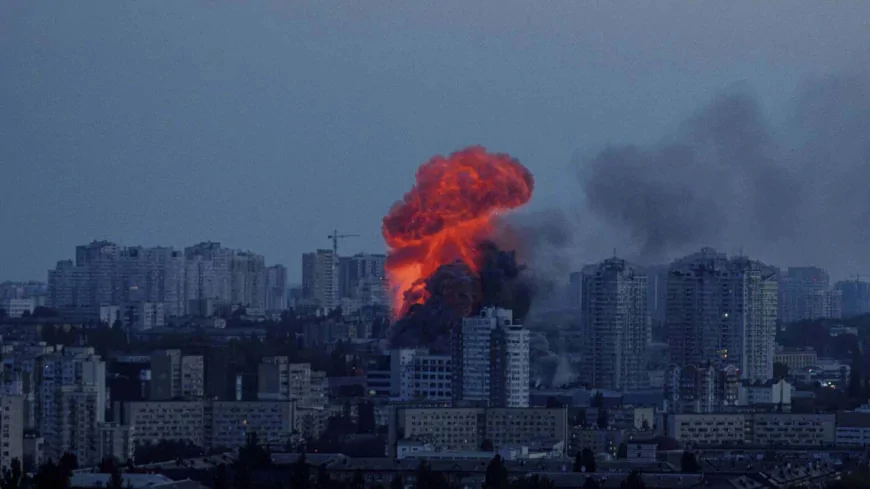
Russian forces launched 155 drones against Ukrainian territory overnight, including approximately 100 Shahed-type munitions, in one of the largest single-night barrages since the full-scale invasion began in February 2022. Ukraine's Air Force reported intercepting 136 of the incoming drones, but the remaining strikes caused damage to energy infrastructure and residential areas in multiple oblasts. The Russian General Staff's cumulative losses, according to Ukraine's General Staff, now stand at 1,270,400 troops killed or wounded since the invasion began — with 900 casualties recorded in the preceding 24-hour period alone.
President Volodymyr Zelensky confirmed what Western diplomatic observers had quietly suspected: the prospect of meaningful trilateral peace negotiations involving Ukraine, Russia, and the United States has been placed on indefinite hold as the Trump administration redirects its diplomatic and military resources toward the conflict with Iran. "Trilateral peace talks are on hold due to the war between Washington and Tehran," Zelensky said plainly on Tuesday — a statement as revealing for what it implies about prior American engagement as for what it says about current American priorities.
The combination of a large-scale drone offensive and the collapse of the diplomatic track signals that Moscow is reading the geopolitical moment with characteristic strategic opportunism. With Washington absorbed by Iran, European attention fragmented, and no active negotiation process to constrain escalation, the Kremlin appears to have calculated that the cost of intensified operations against Ukraine has temporarily fallen.
The Peace Talks That Were and the Talks That Aren't
The trilateral framework Zelensky referenced had been quietly constructed over the preceding months, with US envoys serving as mediators between Kyiv and Moscow in a format that excluded European allies — a structural choice that generated significant friction in Brussels and particularly in Warsaw. The framework's suspension leaves Ukraine in a diplomatically exposed position: the country's most important external security partner is engaged in a shooting war in a different theatre, and the ceasefire agreement that many Ukrainian officials had regarded with deep ambivalence appears to be receding rather than approaching.
Slovakia's Prime Minister Robert Fico complicated the diplomatic picture further on Wednesday, claiming he possesses satellite imagery proving that the Druzhba oil pipeline has not been damaged — a claim that directly contests Ukrainian and European assertions about Russian sabotage of the pipeline and appears designed to reopen a debate that could weaken EU unity on energy sanctions against Moscow.
According to Dr. Olga Oliker, Director of the Europe and Central Asia Programme at the International Crisis Group, "Russia is operating exactly as it has since 2022 — looking for every window of opportunity that opens when the United States is preoccupied elsewhere. The drone barrage and the peace talks freeze are not separate events. They are parts of a single strategic message."
The Cumulative Cost: Beyond 1.27 Million
The General Staff's figure of 1,270,400 total Russian casualties — including killed and wounded — is not independently verified and should be understood as a Ukrainian government estimate. Western intelligence assessments have generally placed Russian losses in a range consistent with Ukrainian claims, though methodology differences mean precise numbers remain contested. What is not contested is that the war has destroyed Russian military capacity at a scale unprecedented in post-Cold War European history.
Russia has simultaneously maintained a sufficient operational tempo to continue launching large-scale attacks, fed by a defence-industrial mobilisation that Western assessments have described as running ahead of original projections. The combination of catastrophic losses and sustained production capacity is perhaps the defining strategic paradox of the conflict — and one that has no clear resolution on the horizon.
With peace talks frozen, the battlefield is the only arena where the conflict's future is being decided. Whether the Iran war extends long enough to permanently remove US diplomatic bandwidth from the Ukraine file — or whether Washington eventually returns to the table — is the question on which Ukraine's political future now most directly depends.
Ukraine's Energy Infrastructure and the Coming Spring Offensive Season
The drone attack — one of the largest single-night barrages of the war — targeted power generation and distribution infrastructure across multiple Ukrainian oblasts, following a pattern that Russian military planners have deployed since the autumn of 2022: systematic strikes on the energy grid timed to maximise civilian suffering and undermine the Ukrainian government's capacity to maintain basic services. Ukraine's energy sector has demonstrated remarkable resilience and repair capacity, supported by European equipment transfers and technical assistance, but the cumulative damage of four years of targeted infrastructure attacks has degraded baseline generating capacity and left Ukraine chronically dependent on European power grid connections.
As the spring fighting season approaches — when weather conditions in eastern Ukraine shift from the mud that slows armoured operations to the firmer ground that enables them — both sides are preparing for a period of intensified ground contact. Russian forces have spent the winter months attempting to consolidate positions around Pokrovsk and Kurakhove in Donetsk Oblast, applying sustained pressure designed to grind down Ukrainian defensive lines. Ukraine's military command has signalled intentions to maintain strategic depth rather than undertake major offensive operations in the current period.
The suspension of the US diplomatic engagement channel and the continued Russian drone offensive describe an environment in which a spring escalation becomes more likely, not less. European leaders meeting this week at various institutional formats are grappling with the question of what additional military support to Ukraine is feasible in a period when their own defence industries are stretched and when US attention is directed elsewhere. The answer, for now, is: not enough.
What's Your Reaction?
 Like
0
Like
0
 Dislike
0
Dislike
0
 Love
0
Love
0
 Funny
0
Funny
0
 Wow
0
Wow
0
 Sad
0
Sad
0
 Angry
0
Angry
0









Comments (0)