

Canada's Carney Refuses to Rule Out Iranian War Role at Australia
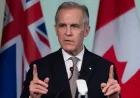
Canadian PM Mark Carney declined to rule out military involvement in the Iran conflict during a joint press conference with Australia's PM in Canberra.
Key Takeaways
- Canadian PM Mark Carney declined to rule out military involvement in the Iran conflict during a joint press conference with Australia's PM in Canberra.
- Carney Leaves Canadian Military Door Ajar in Canberra as Allied Pressure on Iran War Mounts Canadian Prime Minister Mark Carney declined Thursday to categorically rule out Canad...
- Published: Mar 05, 2026 — Canada

Carney Leaves Canadian Military Door Ajar in Canberra as Allied Pressure on Iran War Mounts
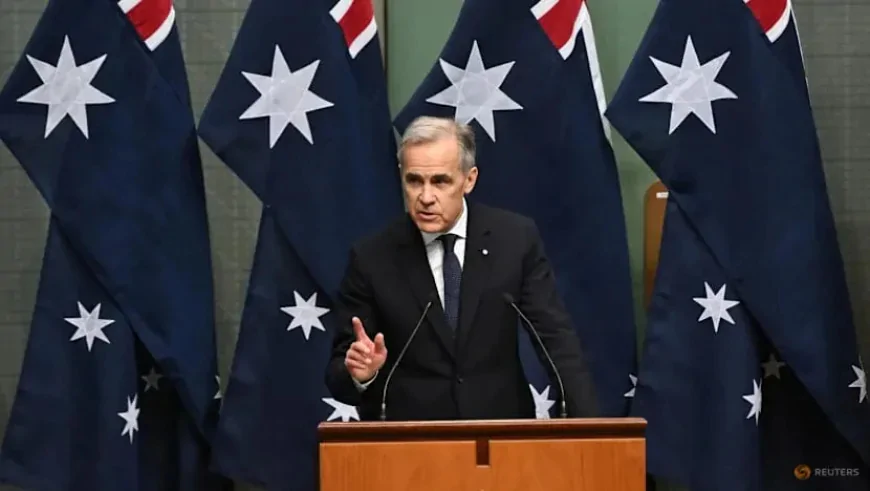
Canadian Prime Minister Mark Carney declined Thursday to categorically rule out Canadian military participation in the US-Israel war against Iran during a joint press conference with Australian Prime Minister Anthony Albanese in Canberra, a formulation that — while carefully hedged — represents a significant departure from Canada's initial posture of allied solidarity without operational commitment. Carney is in Australia for bilateral consultations, but the Iran war has overshadowed every aspect of the visit.
"You've asked a fundamental hypothetical in a conflict that can spread very broadly," Carney told reporters who pressed him on whether Canadian forces would ever join the conflict. "So one can never categorically rule out participation. We will stand by our allies when it makes sense," he added. The statement is not an announcement of Canadian military action — Canada has not deployed forces to the theatre, and no decision to do so has been made. But the refusal to exclude participation unambiguously is itself a political signal, directed at both domestic audiences and allied capitals.
Albanese and Carney used the Canberra press conference to coordinate what appears to be a joint allied narrative on Iran war objectives. Both leaders stressed that any diplomatic resolution of the conflict must address Iran's nuclear capacity and its role in exporting what they described as terrorism. "We stress that that cannot be achieved unless we are in a position that Iran's ability to acquire a nuclear weapon, develop a nuclear weapon, and to export terrorism, is ended," Carney said. Albanese added: "The world wants to see a de-escalation and wants to see Iran cease to spread the destinations of its attacks."
What Canadian Participation Would Actually Mean
Canada is a Five Eyes partner, a NATO member, and holds bilateral defence agreements with the United States that create real, if not legally determinative, pressure to contribute to allied military operations. In practical terms, Canadian participation in the Iran war would most likely take the form of naval assets in the Persian Gulf, air-to-air refuelling or surveillance aircraft, or expanded intelligence sharing — rather than ground forces or offensive strike missions, which would require parliamentary approval under Canadian domestic law.
Canadian governments have historically navigated the gap between allied solidarity and domestic political constraint by contributing to the support and intelligence architecture of coalition operations while avoiding the most politically exposed combat roles. Canada did not deploy ground forces to Iraq in 2003 despite intense American pressure, but participated in the Afghanistan mission through NATO for more than a decade. The Iran precedent is closer to a potential Iraq scenario — a US-led operation without UN Security Council authorisation, where the legal and political costs of participation are higher.
According to Dr. Philippe Lagassé, Professor of International Affairs at Carleton University and a specialist in Canadian defence policy, "Carney's language is carefully designed to preserve allied relations without making a commitment that parliament hasn't endorsed. But 'one can never rule it out' is not neutral language. It signals to Washington that Ottawa is a willing participant in the political and moral framing of this war — and that a threshold exists at which Canadian forces could be made available."
Australia's Deeper Exposure and the Pacific Dimension
Australia's position in the Iran war debate is substantially more complex than Canada's. Albanese leads a government that depends heavily on US security guarantees for its strategic posture toward China and has large numbers of US military personnel stationed on Australian soil under the AUKUS agreement's force posture provisions. Australia has already increased intelligence-sharing with the US-Israeli coalition and has moved additional naval assets to positions closer to the conflict zone.
Albanese's statement that "the world wants to see a de-escalation" carries the ambiguity characteristic of a leader trying simultaneously to signal restraint to domestic audiences — who polls show are deeply sceptical of Australian involvement in a Middle East war — and solidarity to the US alliance partner on whose military support Australia's Pacific security strategy depends.
Both leaders left Canberra without announcing any material change in their countries' operational postures. But the political direction of both statements — the refusal to rule out, the framing of Iranian nuclear and terrorist capacity as the conflict's legitimate objective, the synchronisation of language with US positions — tells a clearer story than the careful hedges in which it is wrapped. Canada and Australia are not yet at war with Iran. Whether they remain outside the conflict depends on how the coming days develop, and on what Washington asks of its closest allies in the weeks ahead.
The AUKUS Dimension and the Costs of Alliance in a Multifront War
Australia's strategic position in the Iran war debate is shaped by the AUKUS agreement in ways that Canada's is not. Under AUKUS's first pillar, Australia is committed to acquiring nuclear-powered submarines with US technology, a programme that involves the rotational stationing of US and UK submarines at HMAS Stirling in Western Australia. That military integration creates a level of operational interdependence with US forces that goes well beyond the intelligence-sharing and equipment-transfer relationships that characterise Canada's defence relationship with Washington.
Albanese's government has navigated the AUKUS commitment with care, maintaining support for the programme while projecting diplomatic independence — notably in Australia's continued engagement with China as its largest trading partner despite the AUKUS framework's clear anti-China strategic logic. The Iran war is now testing whether that dual posture is sustainable. If Washington asks Canberra for specific operational support — surveillance flights, logistics access, intelligence sharing on Middle East networks — the AUKUS interdependence makes a flat refusal difficult to manage without damaging the foundation of Australia's principal security relationship.
Carney's refusal to rule out Canadian participation and Albanese's coordination of allied narrative language in Canberra describe two governments that are managing the same fundamental problem: how to maintain allied solidarity with a United States engaged in a war that their domestic publics did not endorse, that international law does not clearly legitimate, and that their own strategic interests counsel watching rather than joining. The political cost of getting that balance wrong, in either direction, is high. The press conferences are being managed carefully. The decisions behind them are harder.
What's Your Reaction?
 Like
0
Like
0
 Dislike
0
Dislike
0
 Love
0
Love
0
 Funny
0
Funny
0
 Wow
0
Wow
0
 Sad
0
Sad
0
 Angry
0
Angry
0




Comments (0)