

Iran Strikes Bahrain Oil Refinery as Hormuz Closure Bites
Iran struck a Bahrain oil refinery and confirmed closure of the Strait of Hormuz to US, Israeli and European vessels, spiking global oil prices above $90 per barrel.
Key Takeaways
- Iran struck a Bahrain oil refinery and confirmed closure of the Strait of Hormuz to US, Israeli and European vessels, spiking global oil prices above $90 per barrel.
- Iran Strikes Bahrain Refinery and Shuts Hormuz, Sending Energy Markets Into Turmoil An Iranian missile struck an oil refinery in Bahrain on Thursday, according to a Bahraini gov...
- Published: Mar 05, 2026 — Middle east

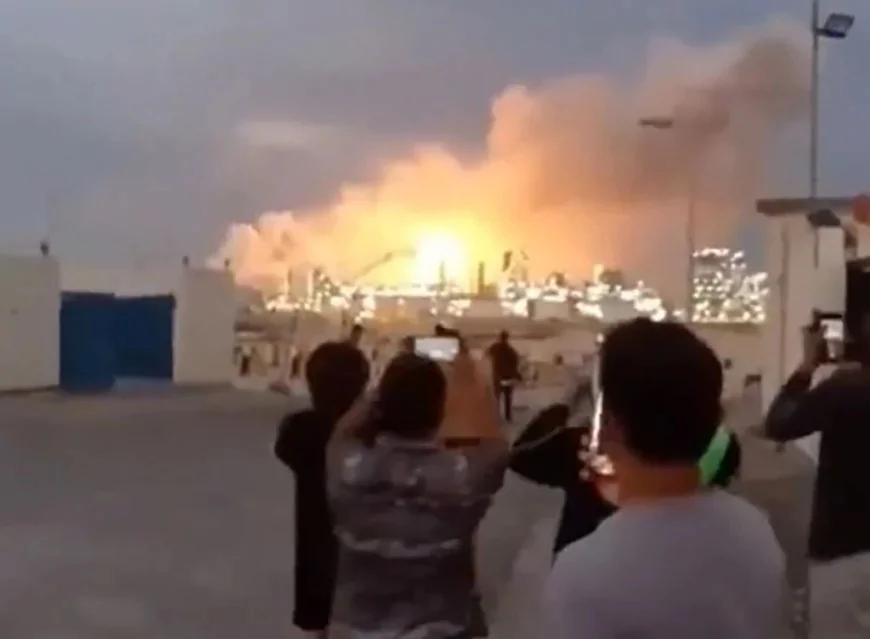
Iran Strikes Bahrain Refinery and Shuts Hormuz, Sending Energy Markets Into Turmoil
An Iranian missile struck an oil refinery in Bahrain on Thursday, according to a Bahraini government press release confirmed by video footage posted to social media, marking the first direct Iranian attack on Bahraini energy infrastructure since the US-Israeli strikes on Iran began six days ago. The strike came hours after Iran's Islamic Revolutionary Guard Corps formally announced the closure of the Strait of Hormuz to all vessels from the United States, Israel, and European nations — a move that has brought maritime activity through one of the world's most critical energy chokepoints to near-total standstill.
Oil prices responded immediately. Brent crude crossed $90 per barrel during Thursday trading — a level not seen since early 2025. The Strait of Hormuz carries approximately 20 percent of the world's traded oil, and the IRGC's announcement, however partial in its application, has been enough to halt nearly all commercial shipping through the passage. Insurers have suspended cover for vessels transiting the strait. Lloyd's of London issued an emergency advisory Thursday morning.
The Bahrain refinery strike adds to an escalating pattern of Iranian attacks on Gulf infrastructure. Earlier in the week, Iranian drones targeted Amazon data centers in Bahrain and the United Arab Emirates. Several warplanes from the US-led coalition reportedly crashed in Kuwait. An explosion damaged a tanker anchored southeast of Kuwait's port. The regional infrastructure war is being fought alongside the air campaign over Tehran.
Bahrain: Front Line in the Gulf's Proxy War
Bahrain hosts the US Navy's Fifth Fleet — the most powerful naval force in the Persian Gulf — and has been a consistent target of Iranian retaliation since the conflict began. Iranian missiles have struck the Fifth Fleet's headquarters in the Juffair area of Manama multiple times. Bahrain's international airport was struck by a drone earlier in the week, causing material damage without casualties. On Saturday night, several residential buildings in the capital were hit by Iranian drones, and at least three foreign nationals have been killed in Kuwait since the conflict began.
The Bahraini government has maintained public composure while quietly absorbing extraordinary military pressure. King Hamad bin Isa Al Khalifa held an emergency meeting of the National Security Council on Thursday following the refinery strike. No formal statement of retaliation has been issued — Bahrain's defense posture relies almost entirely on its American security guarantee, and the government has no independent military capability to respond to Iranian attacks.
According to Dr. Kristin Smith Diwan, senior resident scholar at the Arab Gulf States Institute in Washington, "Bahrain is in an extraordinarily exposed position. It hosts the US military, it is geographically close to Iran, and it has a Shia-majority population that the government has always viewed with suspicion in the context of Iranian influence operations. The refinery strike is both an economic blow and a psychological one — it demonstrates that Iranian reach extends beyond the purely military dimension."
The Hormuz Closure and the Global Energy Cascade
The IRGC's Hormuz closure announcement specified that the closure applies to vessels from the US, Israel, and Europe — not to those from China, India, or other nations. That selective closure is itself a geopolitical signal: Iran is attempting to fracture the international coalition backing the US operation by leaving the door open for non-Western shipping while punishing Western interests. In practice, the uncertainty has been enough to halt all major commercial traffic. No shipping company has been willing to test the waters while Iranian missile batteries and naval mines remain operable in the strait.
Qatar, which is simultaneously under pressure from Iranian missile strikes on the Al Udeid air base and the diplomatic demands of its relationship with Washington, faces a separate energy dilemma. Qatar's LNG exports — the world's largest — transit the Gulf but not the Strait of Hormuz directly. Nevertheless, regional instability has disrupted loading operations, and Qatar's state energy company QatarEnergy has suspended normal shipping schedules as a precaution. The duration of the Hormuz closure is the central variable in the global energy price calculation. Every day it holds adds pressure to economies already absorbing wartime supply shocks that few had prepared for.
The Energy Security Cascade and Global Consequences
The Strait of Hormuz closure, even in its partial and contested form, is producing effects that extend far beyond the Persian Gulf. Asian economies including Japan, South Korea, and India — which collectively import more than 60 percent of their oil from Middle Eastern sources — are scrambling to assess supply resilience and activate strategic reserves. Japan's government held an emergency cabinet meeting Thursday to coordinate with major oil companies on supply security. India's petroleum ministry announced a drawdown of strategic reserves as a precautionary measure.
The closure will also complicate China's calculations. As the world's largest oil importer and Iran's most important economic partner, China is caught between its economic dependence on Gulf oil and its stated opposition to the US-Israeli campaign. The IRGC's Hormuz closure announcement exempting Chinese vessels is partly an attempt to maintain Beijing's commercial relationship with Iran and partly a signal that Iran still views China as a potential diplomatic interlocutor. Whether China uses whatever influence it retains with Tehran to negotiate a reopening of the Strait — or whether it remains passive while the economic consequences of the closure accumulate — will matter enormously to the global economic trajectory in the coming weeks.
In the immediate term, every day the Strait remains closed adds approximately $2-4 per barrel to global oil prices, according to energy trading analysts. At current volumes, the disruption costs the global economy an estimated $1.5 billion per day in elevated energy costs. The political arithmetic of how long that can continue before governments begin to break ranks with the US-led military campaign — because the economic pain of the disruption exceeds the political cost of dissent — is being calculated in capitals from Tokyo to Berlin.
What's Your Reaction?
 Like
0
Like
0
 Dislike
0
Dislike
0
 Love
0
Love
0
 Funny
0
Funny
0
 Wow
0
Wow
0
 Sad
0
Sad
0
 Angry
0
Angry
0















Comments (0)