

Iran Fires Missiles at 27 US Bases Across Middle East in Mass Retaliation
Iran's IRGC launched missiles and drones at 27 US military bases across the Middle East on March 1, 2026, targeting sites in Bahrain, Qatar, Kuwait, Saudi Arabia, Iraq, and Jordan.
Key Takeaways
- Iran's IRGC launched missiles and drones at 27 US military bases across the Middle East on March 1, 2026, targeting sites in Bahrain, Qatar, Kuwait, Saudi Arabia, Iraq, and Jordan.
- Iran Unleashes Massive Retaliatory Barrage Against US Military PositionsIran struck back hard. The Islamic Revolutionary Guard Corps confirmed Sunday, March 1, 2026, that it had...
- Published: Mar 02, 2026 — Middle east


Iran Unleashes Massive Retaliatory Barrage Against US Military Positions
Iran struck back hard. The Islamic Revolutionary Guard Corps confirmed Sunday, March 1, 2026, that it had launched attacks against 27 bases in the Middle East where US troops are deployed, as well as Israeli military facilities in Tel Aviv and other cities across Israel. The barrage began within hours of Iran confirming Supreme Leader Ayatollah Ali Khamenei's death in joint US-Israeli strikes.
The scale of Iran's response shocked regional governments. Ballistic missiles, cruise missiles, and one-way attack drones saturated air defense systems from Bahrain to Jordan. Multiple countries activated emergency protocols, closed international airspace, and scrambled interceptor aircraft. More than 2,400 flights were canceled across Middle Eastern airports on Sunday alone, according to flight tracker FlightAware.
US Central Command confirmed Sunday evening that three American service members had been killed in action and five others seriously wounded. "Several others sustained minor shrapnel injuries and concussions and are in the process of being returned to duty. Major combat operations continue and our response effort is ongoing," US Central Command said in an official statement.
Bahrain, Qatar, Iraq Among Targeted Nations
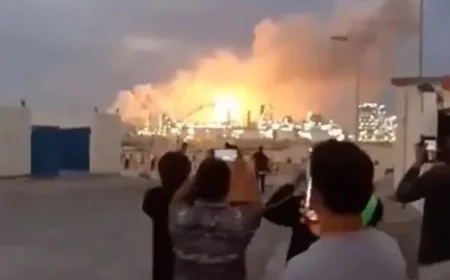
Iranian missiles struck the headquarters of the US Navy's 5th Fleet in Bahrain's Juffair district. Bahrain's Ministry of Interior confirmed that Manama's international airport was also targeted by a drone, causing material damage without loss of life. Several residential buildings in the Bahraini capital were struck by overnight drone attacks, rattling a city long accustomed to quiet.
In Qatar, authorities reported 66 missiles fired at the country. Sixteen people were injured as shrapnel from intercepted missiles fell across multiple locations. Brigadier Abdullah Khalifa Al-Muftah, head of public relations at Qatar's Ministry of Interior, confirmed in a televised address that 114 separate shrapnel reports had been filed nationwide. One person remained in serious condition, he said.
Jordan intercepted 49 drones and ballistic missiles that entered its airspace. In Iraq's semiautonomous Kurdish region, powerful explosions were reported near the US consulate and international airport in Erbil. Two fighters from the Popular Mobilisation Forces were killed and five wounded in US strikes on the Jurf al-Sakher base in southern Iraq.
Gulf States Stunned as Missiles Reach Peaceful Cities
The psychological impact on Gulf Arab states — wealthy, stable nations that had spent decades avoiding direct military confrontation — was immediate and profound. A building in the Seef commercial district of Manama was damaged in the drone attack. Residents of Dubai, Riyadh, and Doha reported hearing unfamiliar alarm systems and watching military aircraft overhead for the first time.
According to Ret. Gen. Frank McKenzie, former commander of US Central Command and CBS News contributor, "Iran's ability to strike simultaneously across this many countries and this many targets in a single night represents a significant evolution of their strike capacity from even five years ago."
Foreign ministers of the six Gulf Cooperation Council states — Bahrain, Kuwait, Oman, Qatar, Saudi Arabia, and the UAE — convened an emergency video conference Sunday to coordinate responses. Whether any of these nations will request US forces to stand down or reduce their presence on Gulf soil to reduce risk remains one of the most consequential open questions of this widening war.
What's Your Reaction?
 Like
0
Like
0
 Dislike
0
Dislike
0
 Love
0
Love
0
 Funny
0
Funny
0
 Wow
0
Wow
0
 Sad
0
Sad
0
 Angry
0
Angry
0












Comments (0)