

Typhoon Noul Weakens in China as Gansu Flash Flood Kills 10 People
Typhoon Noul weakened after hitting Guangdong as a separate Gansu flash flood killed 10, prompting a nationwide red alert across seven Chinese provinces.
Key Takeaways
- Typhoon Noul weakened after hitting Guangdong as a separate Gansu flash flood killed 10, prompting a nationwide red alert across seven Chinese provinces.
- Typhoon Noul Weakens After Landfall as Gansu Flood Kills 10 Typhoon Noul, the strongest storm to strike China this year, weakened to a tropical storm Sunday as it pushed inland...
- Published: Jul 27, 2026 — China

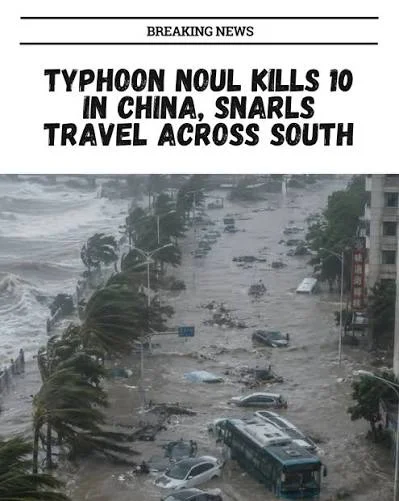
Typhoon Noul Weakens After Landfall as Gansu Flood Kills 10
Typhoon Noul, the strongest storm to strike China this year, weakened to a tropical storm Sunday as it pushed inland after making landfall in Guangdong province, even as a separate flash flood more than a thousand kilometers away in northwestern China's Gansu province killed 10 people and injured 23 others on the same day. More than 801,000 people had been relocated to safety across Guangdong as of Sunday, according to the official Xinhua News Agency, while authorities issued a red warning, the highest level in the country's flood-alert system, for flash floods across seven provinces through Monday evening.
Noul made landfall at around 3:50 a.m. Sunday near Huizhou city in Guangdong, packing winds up to 162 kilometers per hour, before weakening as it moved north-northwest through the province. China's National Meteorological Center said the system was expected to push into southern Hunan in the hours that followed, bringing continued heavy rain to a region already straining under the year's twelfth typhoon. The storm was the third to make landfall in China within a single month, following typhoons Bavi and Maysak, according to Chinese state media, and its winds were slightly stronger than those recorded during Bavi's landfall roughly two weeks earlier.
Flash Floods Add a Second Crisis in the Northwest
While Guangdong absorbed the brunt of Noul's landfall, a separate and unrelated disaster unfolded in Gansu province, where a sudden flash flood struck a scenic tourist area in Weiyuan County on Sunday afternoon. Local authorities said the flood, triggered by intense rainfall, trapped a group of tourists who had been camping in the area when the water surged. Search-and-rescue teams from local public security and fire departments were dispatched to the site, with the death toll reaching 10 and 23 injured as of 6 p.m. Sunday, according to the state-run Xinhua News Agency.
China's Ministry of Water Resources and the China Meteorological Administration jointly issued the red warning covering Jiangxi, Hunan, Guangdong, Sichuan, Shaanxi, Gansu, and southeastern Xinjiang from Sunday evening through Monday evening, urging residents to "pay attention to real-time monitoring, flood warning, and evacuation and risk avoidance prevention." The dual emergencies, a coastal typhoon and an inland flash flood hundreds of miles apart, have stretched national disaster-response resources at a time when China's summer storm season has already proven unusually active.
Hong Kong Disruption and Economic Toll
In Hong Kong, the typhoon's outer bands canceled roughly 350 flights and stranded about 2,000 passengers at the city's airport over the weekend, according to airport authority figures cited by the Associated Press. At least 21 people were injured across the city during the typhoon period, Hong Kong authorities said, while the observatory lowered its tropical cyclone warning signals Sunday as Noul moved inland away from the territory. Hong Kong's government also reported 29 temporary shelters opened during the storm and more than 300 reports of fallen trees across the semi-autonomous territory, though officials said the overall disruption was less severe than initially feared given the storm's weakening trajectory. By Monday morning, flights at Guangzhou, Macau, and Shenzhen airports were reported operating normally, with only minor delays remaining at Hong Kong's airport.
Hunan province, in the storm's projected inland path, activated a third-level emergency response covering fourteen cities and prefectures ahead of Noul's arrival, with forecasters predicting between 80 and 200 millimeters of rain in the province's eastern and northern regions and local maximums potentially exceeding 300 millimeters. The province's disaster-response agencies said crews were pre-positioned along vulnerable riverbanks and mountain communities in anticipation of the storm's continued push inland through Monday.
China's National Development and Reform Commission said it had allocated 100 million yuan, roughly $14.8 million, to support recovery efforts in typhoon-affected areas of Guangdong. China's National Commission for Disaster Prevention, Reduction and Relief activated a Level-IV national disaster relief emergency response for the province, the least severe tier in the country's four-level system, while a working team was dispatched to assess damage and assist local authorities with relocation and resettlement of displaced residents.
Background & Context
China regularly faces destructive summer flooding and typhoons, a pattern that has intensified in recent years as the country's disaster-response agencies contend with increasingly frequent and severe weather events tied to a warming climate. This July alone has brought a string of deadly disasters beyond Noul and the Gansu flash flood, including flooding tied to Typhoon Maysak in Guangxi and storm-related deaths in Hubei province, according to regional weather monitoring reports reviewed by international outlets covering the disasters.
The scenic area struck by Sunday's flash flood in Gansu draws domestic tourists during the summer camping season, and local officials have faced questions in past years over warning systems for visitors in remote mountain and river-adjacent areas prone to sudden flooding. China's National Meteorological Center has said flash floods of this kind, triggered by sudden and intense rainfall over a short window, remain difficult to forecast with enough lead time to evacuate all visitors from vulnerable tourist sites, a challenge that has repeated itself across multiple provinces this summer.
China's four-tier color-coded typhoon warning system, with red representing the most severe alert level, was activated ahead of Noul's landfall on Saturday, giving coastal authorities roughly a day's notice to complete the bulk of Guangdong's relocation effort. Provincial disaster officials credited the advance warning with keeping the storm's confirmed death toll in Guangdong itself relatively contained compared with the separate, harder-to-predict flash flood in Gansu, illustrating the differing challenges posed by coastal typhoons versus inland flash flooding events.
For residents across the seven provinces now under the red flood warning, the coming days will test both the speed of the country's disaster-relief apparatus and the resilience of communities already reeling from a summer of overlapping natural disasters. Authorities have not yet provided a consolidated national death toll spanning all of July's separate flooding and storm events, though local tallies from Guangxi, Hubei, Guangdong, and Gansu suggest the cumulative human cost is significant.
Frequently Asked Questions
What happened?
Typhoon Noul made landfall in Guangdong as China's strongest storm this year, while a separate flash flood in Gansu province killed 10 people the same day, prompting a nationwide red flood warning.
Why does this matter?
The twin disasters highlight an unusually active storm season in China, straining disaster-relief resources across multiple provinces simultaneously.
Who is affected?
More than 801,000 people were relocated in Guangdong, dozens were injured in Hong Kong and Gansu, and seven provinces remain under high flood alert.
What happens next?
Authorities will continue relief operations in Guangdong and Gansu while monitoring the red flood warning region through Monday evening for further flash flood risk.
What's Your Reaction?
 Like
0
Like
0
 Dislike
0
Dislike
0
 Love
0
Love
0
 Funny
0
Funny
0
 Wow
0
Wow
0
 Sad
0
Sad
0
 Angry
0
Angry
0
















Comments (0)