

Trump Administration Declares “Armed Conflict” with Caribbean Cartels, Launches Secret Military Strikes
The Trump administration has declared the U.S. is in an “armed conflict” with Caribbean drug cartels—authorizing lethal military strikes without congressional approval. At least 17 killed, no public evidence released. Legal experts warn of dangerous executive overreach. Full report on EpochPost.
Key Takeaways
- The Trump administration has declared the U.S. is in an “armed conflict” with Caribbean drug cartels—authorizing lethal military strikes without congressional approval. At least 17 killed, no public evidence released. Legal experts warn of dangerous executive overreach. Full report on EpochPost.
- In a move that has ignited alarm among lawmakers, legal scholars, and human rights groups, the Trump administration has formally declared the United States to be in an “armed co...
- Published: Oct 03, 2025 — U.S. News

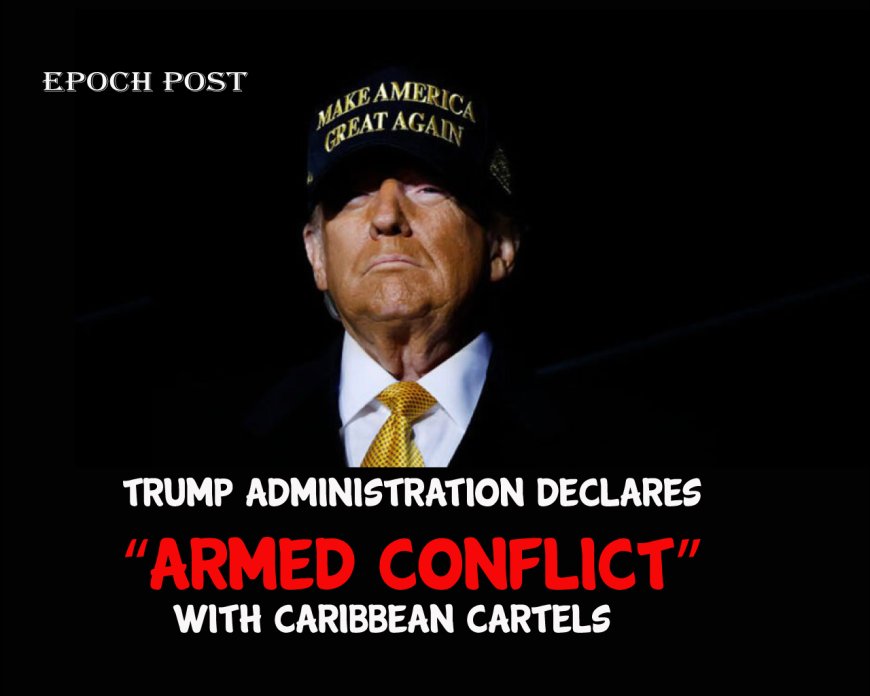
In a move that has ignited alarm among lawmakers, legal scholars, and human rights groups, the Trump administration has formally declared the United States to be in an “armed conflict” with Caribbean drug cartels—invoking wartime authorities to justify lethal military strikes in international waters, without congressional authorization.
According to a confidential notice sent to Congress and obtained by The New York Times, the administration now classifies transnational drug cartels as “nonstate armed groups” whose actions “constitute an armed attack against the United States.” This designation allows the White House to label traffickers as “unlawful combatants”—a legal category that, if accepted, could permit their targeting like enemy soldiers in wartime.
At Least 17 Killed in “Presidentially-Directed” Strikes
Since early September, U.S. military assets have carried out three confirmed strikes in the Caribbean:
September 2: 11 killed on a vessel allegedly carrying members of Venezuela’s Tren de Aragua gang. Trump claimed they were “operating under the control of Nicolás Maduro.”
September 15: 3 more killed in a second operation.
September 19: At least 3 additional deaths on a boat described as “trafficking illicit narcotics en route to poison Americans.”
The administration asserts these actions were “directed by the President consistent with his responsibility to protect Americans,” citing his authority as Commander in Chief.
Yet no evidence has been made public, no independent investigation launched, and no congressional debate held.
Venezuela has denied any link between the September 2 victims and Tren de Aragua—raising serious questions about whether the U.S. may have conducted extrajudicial killings based on unverified intelligence.
Legal Experts Warn of Constitutional Breach
Critics argue the administration is exploiting a legal loophole with dangerous precedent.
“Every American should be alarmed that President Trump has decided he can wage secret wars against anyone he labels an enemy,” said Senator Jack Reed (D-RI), ranking member of the Senate Armed Services Committee.
Under U.S. and international law, drug trafficking—even when deadly—does not constitute an “armed attack” that justifies wartime lethal force. The Alien Enemies Act and existing terrorist designations permit deportation or asset seizure, not drone strikes or naval killings.
“The use of lethal force on suspicion of illegal activity violates over a century of international humanitarian law,” said the Washington Office on Latin America (WOLA).
A former senior Pentagon legal adviser added:
“This is an enormous expansion of executive power with no clear boundaries. Lethal force must be the exception—not the rule.”
Dismantling Civilian Drug Enforcement While Militarizing the Response
The shift toward military action coincides with a sharp decline in traditional drug enforcement:
Federal drug prosecutions have hit a 40-year low.
Over 2,000 DEA agents have been reassigned to immigration duties.
The Justice Department is reportedly preparing to shutter the Organized Crime Drug Enforcement Task Forces (OCDETF)—the very agency designed to dismantle major trafficking networks.
In effect, while the administration wages covert military operations abroad, it is dismantling civilian tools meant to combat drugs at home.
Escalating Tensions with Venezuela
By publicly tying Tren de Aragua to Venezuelan President Nicolás Maduro, the White House risks inflaming tensions with a hostile regime. If the connection is unsubstantiated—as Caracas insists—the U.S. could be violating international law by conducting lethal operations against foreign nationals without provocation.
What began as a “war on drugs” now increasingly resembles a covert campaign against Venezuela—conducted in secrecy, without oversight, and beyond the bounds of declared war powers.
Congress Remains in the Dark
To date, no military authorization has been sought or granted by Congress. The strikes were not subject to public hearings, judicial review, or even internal interagency scrutiny.
The White House has declined to comment or release the legal memos justifying the operations, citing “national security.”
🔍 Why This Matters
This unprecedented move tests the limits of presidential power—and the very definition of war. If a president can unilaterally declare “armed conflict” against criminal organizations, what stops future administrations from doing the same against gangs, hackers, or even domestic groups?
Source:
https://www.nytimes.com/2025/10/02/us/politics/trump-drug-cartels-war.html
What's Your Reaction?
 Like
0
Like
0
 Dislike
0
Dislike
0
 Love
0
Love
0
 Funny
0
Funny
0
 Wow
0
Wow
0
 Sad
0
Sad
0
 Angry
0
Angry
0






Comments (0)