

Chile's Economy Contracts for First Time in Months, Hormuz Shock Deepens Worry
Chile's economic activity shrank 0.1% year-on-year in January — its first contraction in months — as copper demand slows and the Strait of Hormuz closure threatens to add an inflation shock.
Key Takeaways
- Chile's economic activity shrank 0.1% year-on-year in January — its first contraction in months — as copper demand slows and the Strait of Hormuz closure threatens to add an inflation shock.
- Chile Posts Surprise Economic Contraction as Copper Slowdown BitesChile's economy contracted 0.1 percent year-on-year in January 2026, the country's statistics agency confirmed ...
- Published: Mar 03, 2026 — World News

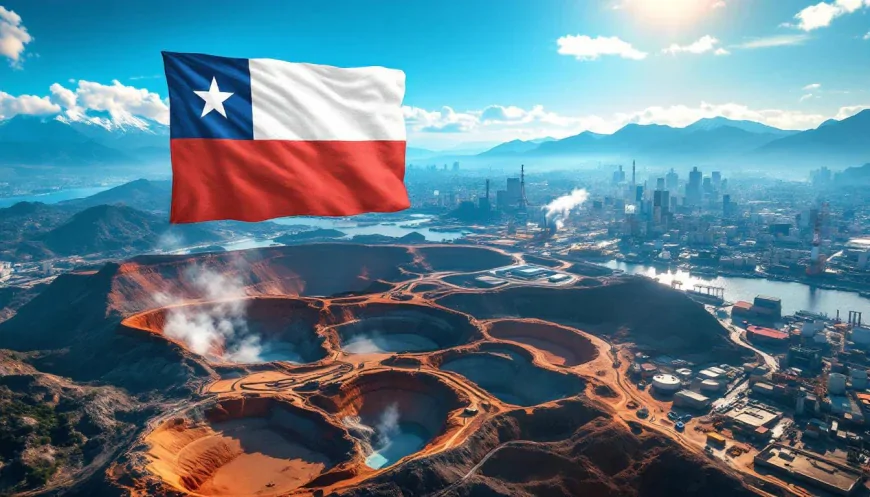
Chile Posts Surprise Economic Contraction as Copper Slowdown Bites
Chile's economy contracted 0.1 percent year-on-year in January 2026, the country's statistics agency confirmed Tuesday — a jarring miss against the 1.1 percent growth economists had forecast and a stark reversal from December's 1.7 percent expansion. It marks the first outright monthly contraction in Chile's economic activity in several months, arriving at a moment when the country is simultaneously navigating a change of government and absorbing the early shockwaves of the global energy disruption triggered by the U.S.-Israel war with Iran.
Chile's economy is more exposed to China's economic trajectory than almost any other in Latin America, through its position as the world's largest copper producer. Copper accounts for roughly half of Chile's export revenue, and as China's demand outlook dimmed amid global geopolitical uncertainty and its own domestic property sector challenges, the revenue foundation that had sustained Chilean growth began to erode in the final weeks of 2025. The January contraction is the clearest signal yet that the erosion has become a contraction.
The timing is particularly sensitive. Chile is preparing to swear in what analysts describe as its most radically free-market government in more than 35 years, led by President-elect José Antonio Kast. Many traders and international investors are watching the incoming administration's policy programme closely, but the dominant market attention on Tuesday was not on Santiago — it was on the Persian Gulf.
Hormuz Closure Adds a New Layer of Inflationary Risk
The IRGC's overnight declaration formally closing the Strait of Hormuz sent commodity markets into emergency repricing mode. For Chile, the implications are dual. As an oil and natural gas importer, Chile faces higher energy costs filtering through to domestic inflation and household budgets already strained after years of pandemic-era price pressures. For the new free-market government arriving in a few weeks, an oil-driven inflation shock would be a uniquely challenging first test — raising prices and squeezing consumers at the same moment the administration is seeking to build confidence in its economic programme.
Brazil's manufacturing PMI inched up to 47.3 from 47.0 but remained firmly in contraction territory. Mexico's manufacturing PMI improved to 47.1 from 46.3 — still signalling contraction. Across Latin America, the pattern was consistent: energy-importing economies faced a cost-of-living headwind that policymakers had no direct tool to address. South Africa's manufacturing PMI deteriorated further along the same lines.
The ISM Manufacturing Prices Paid index in the United States exploded to 70.5 in February — up 11.5 points from 59.0 in January and its highest reading since June 2022. Economists at Vital Knowledge noted this was the leading signal of a CPI spike that typically follows within three to six months, raising the prospect of a global inflationary re-acceleration just as central banks had been prepared to begin rate-cutting cycles.
Petrobras a Rare Bright Spot in the Regional Gloom
Not every Latin American economy faced uniform pressure. Brazil's Petrobras surged 4.58 percent Monday on Brent crude's 6.68 percent spike, reaching its highest level since May 2024. The state oil company is a direct beneficiary of higher crude prices, providing an unusual macroeconomic cushion for Brazil even as it raised jet fuel prices 9.4 percent in March — a reminder that oil's winners and losers are sometimes the same entity.
The Iran ambassador to Brazil issued a statement expressing hope that the war "will not interfere with fertilizer trade" — an economic signal of unusual specificity, given that Iran supplies a meaningful portion of Brazil's agricultural inputs. Disruption to fertilizer supply chains would ripple through Brazil's agricultural sector, one of the largest in the world.
According to Claudio Iriarte, chief Latin America economist at Barclays, "Chile's January contraction is a domestic warning sign amplified by an external shock — and that external shock just got significantly worse overnight with the Hormuz closure."
Whether Chile's incoming government chooses to prioritise fiscal discipline or counter-cyclical spending in its opening economic programme — and whether that choice proves correct as global conditions deteriorate — will define its early political credibility.
What's Your Reaction?
 Like
0
Like
0
 Dislike
0
Dislike
0
 Love
0
Love
0
 Funny
0
Funny
0
 Wow
0
Wow
0
 Sad
0
Sad
0
 Angry
0
Angry
0













Comments (0)