














































Somalia's Jubaland Rejects Federal Constitutional Amendments Crisis
Somalia's Jubaland formally rejected Mogadishu's constitutional amendments, escalating a standoff that threatens the country's fragile federal stability.
Jubaland's Rejection of Mogadishu's Constitutional Changes Opens New Front in Somalia's Political Crisis
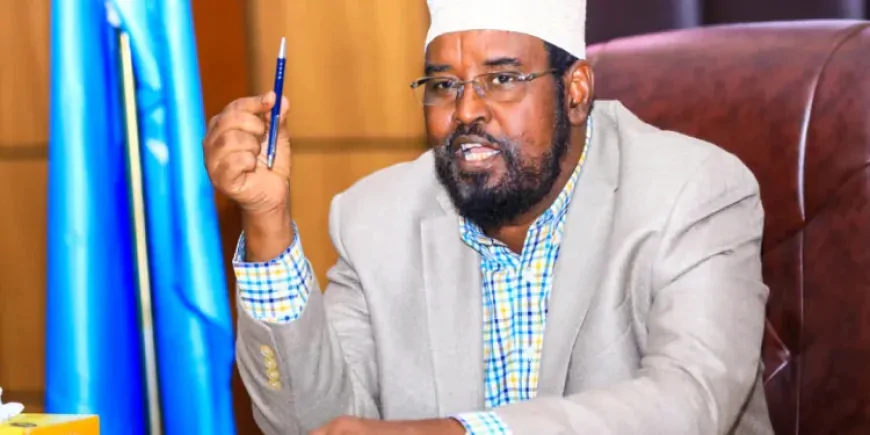
Somalia's Jubaland federal member state formally rejected constitutional amendments proposed by the federal government in Mogadishu on Thursday, describing them as unilateral, unconstitutional, and a threat to the power-sharing architecture that has held the Somali state's patchwork of federal regions together since 2012. The Jubaland administration, led by President Ahmed Madobe, issued a public statement refusing to recognise the amendments' validity and calling on all federal member states to resist what it described as an attempt by President Hassan Sheikh Mohamud to concentrate power in the federal government at the expense of constitutionally protected regional autonomy.
The confrontation is the most direct political standoff between Mogadishu and a federal member state since Somalia began its formal federal transition more than a decade ago, and it arrives at a moment when the country faces compounding pressures: a parliamentary mandate due to expire in April, a presidential mandate expiring in May, an Al-Shabaab insurgency that has capitalized on political infighting to expand its operations, and an international community distracted by the Iran war and unable to dedicate sustained attention to Somali governance crises.
At the centre of the dispute are amendments that opposition politicians and federal member state leaders argue would alter the distribution of powers between Mogadishu and the regions without the constitutionally required consent of the federal member states. President Hassan Sheikh Mohamud's government has framed the amendments as technical updates necessary to enable elections and improve governance; critics, including Jubaland and Puntland, have characterised them as a power grab dressed in procedural language.
The Electoral Mandate Crisis Underneath the Constitutional Fight
The constitutional dispute cannot be separated from a deeper crisis of political legitimacy. Somalia's parliament was elected in 2021 under a complex clan-based indirect voting system; its term expires in April 2026. The presidential mandate of Hassan Sheikh Mohamud, who won a parliamentary vote to become president in May 2022, expires in May 2026. Both institutions are therefore operating with diminishing democratic legitimacy as the months advance.
The federal government had been in talks with federal member states about the timeline and format of the next election cycle. Those talks have now broken down over the constitutional amendments issue, meaning that the two most important institutions in the Somali state — the parliament and the presidency — risk entering a period of contested legitimacy simultaneously, in a country where contested legitimacy creates direct physical danger.
Al-Shabaab, the Al-Qaeda-linked insurgency that controls significant rural territory in southern Somalia and continues to conduct high-casualty operations in and around Mogadishu, has consistently exploited periods of political fragmentation to advance its own territorial and administrative ambitions. The group's assault on a high-security prison in Mogadishu in October 2025 — which freed dozens of its members — demonstrated its continued operational capacity and its ability to time major operations to coincide with political vulnerability in the federal government.
According to Dr. Ken Menkhaus, Professor of Political Science at Davidson College and a long-time Somalia analyst, "The recurring pattern in Somali politics is that constitutional and electoral crises are never just political — they immediately become security crises because all the armed actors in the country recalibrate their behaviour based on government weakness. Jubaland's rejection of the amendments is legally and politically defensible, but the timing, combined with the mandate expiry, is genuinely dangerous."
International Recognition of Somaliland and the Regional Dimension
The Jubaland crisis is occurring alongside a separate challenge to Somali sovereignty in the north. Israel's recent recognition of Somaliland — the self-declared independent territory that broke from Somalia in 1991 and has maintained de facto independence since — has energised Somaliland's diplomatic push for international recognition while deepening Mogadishu's sense of external pressures converging on the Somali state's coherence.
The Ethiopian dimension adds further complexity: Addis Ababa has been in negotiations with Somaliland for access to the Red Sea coast, an arrangement that Mogadishu has opposed as an infringement on Somali sovereignty. That dispute has been partially paused but not resolved. The combination of internal constitutional crisis, approaching electoral legitimacy expiry, external recognition challenges, and ongoing insurgency describes a political environment in which any individual failure could trigger systemic collapse. What Mogadishu does in the next thirty days — whether it compromises with Jubaland or pushes the confrontation — will be consequential.
Al-Shabaab's Strategic Patience and the Government's Narrowing Options
Al-Shabaab's capacity to exploit Somalia's political fragmentation is not a new development; it is the group's defining strategic characteristic. The organisation, founded in 2006 as a youth militia within the Islamic Courts Union and transformed into the continent's most capable jihadist organisation through a decade of tactical adaptation, has consistently demonstrated the ability to survive large-scale military pressure campaigns — including the AMISOM offensive that removed it from Mogadishu in 2011 — by trading territory for time and returning when political conditions allow.
The current period of political fragmentation — constitutional dispute between Mogadishu and federal member states, approaching mandate expiry for both parliament and presidency, and reduced international attention due to the Iran war — is precisely the kind of environment in which Al-Shabaab historically has intensified its operations and accelerated recruitment. The group's capacity to provide basic governance functions — dispute resolution, taxation, security — in areas it controls gives it a degree of local legitimacy that the federal government, with its history of internal fragmentation and corruption, struggles to contest.
The federal government's options for resolving the Jubaland crisis are narrowing as the constitutional confrontation intensifies. A negotiated compromise that addresses Jubaland's concerns about federal overreach while maintaining the constitutional reform timeline is theoretically available; whether the political will to pursue it exists within Mogadishu is a separate question. An escalating confrontation with Jubaland while Al-Shabaab watches and waits would represent one of the most foreseeable own goals in recent Somali political history — and one that Somalia's political class has demonstrated, repeatedly, a remarkable capacity to score.