













South Africa Breaks From Past, Votes for UN Ukraine Children Resolution
South Africa joined 90 other countries to vote for a UN resolution on the return of Ukrainian children abducted by Russia — a striking break from its historical pattern of abstaining on Ukraine-related votes.

South Africa's Ukraine Vote Signals the Most Significant Foreign Policy Shift in Years
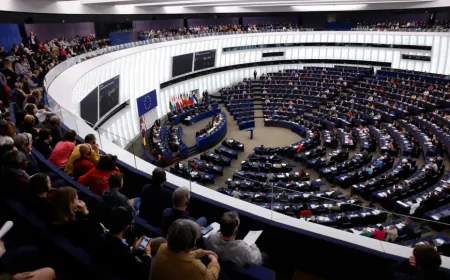
South Africa cast a vote this week in favour of a United Nations General Assembly resolution calling for the return of Ukrainian children abducted and transferred to Russia during the ongoing war — a move that represents the most striking break from its established voting pattern on Ukraine-related resolutions since Russia's full-scale invasion began in February 2022. The resolution passed with 91 votes in favour, and South Africa's decision to join that majority drew immediate attention from analysts in Pretoria, Brussels, and Washington who have been watching whether Cyril Ramaphosa's government will use the changed geopolitical environment of 2026 to recalibrate its foreign policy positioning.
Since February 2022, South Africa has maintained a policy of studied neutrality on Ukraine-related General Assembly votes, abstaining on multiple resolutions condemning the Russian invasion, demanding a ceasefire, or calling for Russian troop withdrawal. That posture was framed by the African National Congress as consistent with its historical commitment to non-alignment and the principles of the 1955 Bandung Conference — a commitment to sovereignty, non-interference, and rejection of Cold War bloc logic. Critics, including the United States and the European Union, characterised the abstentions as a de facto tilt toward Moscow, and U.S.-South Africa relations deteriorated sharply through 2025 over the issue.
The decision to vote yes on the children's resolution — a narrower, less geopolitically charged measure focused on a specific humanitarian and legal obligation rather than on the broader question of Russian responsibility for the war — was carefully chosen. It allows South Africa to signal a shift without abandoning its stated neutrality on the conflict's political dimensions. But the signal is clear, and Russian officials will have noted it.
A Relationship Under Pressure From Multiple Directions
South Africa's foreign policy in 2026 is navigating pressures from every direction simultaneously. The Trump administration expelled the South African ambassador, applied a 30 percent tariff on South African goods, and offered asylum to white South Africans — a set of actions that Ramaphosa described as "baseless and false" in their characterisation of conditions inside the country. The U.S. also excluded South Africa from the G20 in 2026, citing Pretoria's case against Israel at the International Court of Justice under the Genocide Convention — a case Ramaphosa has consistently defended as a matter of international law rather than political positioning.
Simultaneously, South Africa's relationship with Russia has been complicated by the African National Congress's historical ties to Moscow — the Soviet Union supported the ANC during the apartheid era — and by South Africa's membership in BRICS, which includes both Russia and China. A major scandal in 2023, in which South Africa was accused of loading weapons onto a Russian cargo ship docked at a South African naval base, nearly triggered U.S. sanctions and led to congressional hearings in Washington. The ANC vigorously denied the allegations, but the episode left the bilateral relationship badly damaged.
The South African government's South-South diplomatic positioning — maintaining ties with Iran, Cuba, Venezuela, and Russia while simultaneously seeking to attract Western investment — has become increasingly difficult to sustain as those relationships impose higher and higher costs. The Ukraine children's vote may represent the first concrete step toward recalibration.
Ramaphosa's Domestic Position Adds Pressure for Diplomatic Reset
Domestically, Ramaphosa is managing a Government of National Unity formed after the ANC's historic 2024 electoral loss that dropped the party below 50 percent for the first time since the end of apartheid. Coalition governance requires balancing the ANC's traditional foreign policy instincts against the preferences of coalition partners, including the Democratic Alliance, whose more Western-aligned foreign policy positioning has been a persistent source of internal tension. Municipal elections are due in November 2026, with Helen Zille of the DA and Herman Mashaba of ActionSA already declared candidates for Johannesburg mayor — meaning every government decision carries domestic political calculation.
South Africa's 2026 budget allocated more than R1 trillion ($62 billion) to public infrastructure over three years and withdrew an emergency tax plan after revenue collection exceeded Treasury's forecasts. The fiscal improvement provides Ramaphosa with some domestic political cushion, but the country's long-term growth requires Western investment that the current foreign policy posture has made harder to attract.
According to Dr. Chris Landsberg, Professor of Foreign Policy and Diplomacy at the University of Johannesburg, "This vote is small in its legal scope but large in its diplomatic signal. Pretoria is telling both Moscow and Washington that South Africa is capable of principled recalibration — the question is whether it goes further, and how fast."
Whether South Africa's Ukraine children's vote is a one-off gesture or the opening move of a more sustained foreign policy realignment will be tested at the next major UN vote on the Ukraine conflict — and in how Ramaphosa's government navigates the next round of U.S.-South Africa trade and diplomatic tensions later in 2026.