


















































Iranian Drones Hit Azerbaijan's Nakhchivan Airport in Gulf War
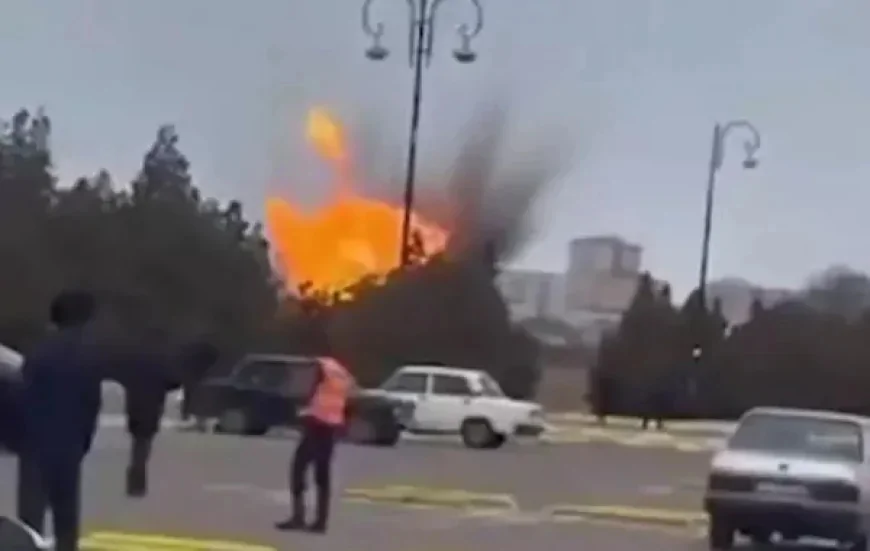
Iranian drones struck Azerbaijan's Nakhchivan International Airport and a nearby village Thursday, marking the first direct strike on a post-Soviet state.
War Without Borders: Iranian Drones Hit Azerbaijan, Raising Fears of Regional Conflagration
Iranian drones struck Nakhchivan International Airport and a village in Azerbaijan's exclave of Nakhchivan on Thursday, the Azerbaijani Foreign Ministry confirmed, marking the most significant geographic expansion of the US-Iran conflict beyond the immediate theatre of operations since hostilities began last Saturday. One drone hit the terminal building at Nakhchivan International Airport; a second landed near a school in Shakarabad, a village situated close to the airport perimeter, at around midday local time. The ministry did not immediately report casualties but convened an emergency session to assess the incident and prepare a formal diplomatic response.
Nakhchivan is a geographically isolated Azerbaijani exclave that shares borders with Iran to the south, Armenia to the north, and Turkey to the west. Its location — separated from Azerbaijan proper by Armenian territory — makes it among the most strategically sensitive pieces of real estate in the South Caucasus. A direct strike on Azerbaijani territory by Iranian munitions, even if the drones were not deliberately targeting Azerbaijani infrastructure, constitutes an act of enormous geopolitical significance.
Azerbaijan has maintained a careful balancing act in its relations with Iran. The two countries share a long border, significant trade ties, and a complex history that includes Iranian concern over the political identity of the estimated 15 to 20 million ethnic Azerbaijanis living inside Iran. Baku has also expanded its defence cooperation with Israel significantly in recent years — a relationship that Tehran views with deep suspicion and that may have contributed to the incident, whether through operational carelessness or deliberate signalling.
The Strategic Logic of the Strike: Accident or Message?
Determining whether the Nakhchivan strike was an operational error — Iranian munitions missing intended targets in Iranian territory and crossing the border — or a deliberate attempt to signal regional costs of the US-Israeli campaign is the central question for Azerbaijani and Western intelligence analysts. The distinction matters enormously for Baku's response and for the regional dynamics of a conflict that is already drawing in actors across the Middle East and Caucasus.
Iranian drone operations have demonstrated a pattern of trajectory errors under conditions of electronic warfare interference, and the proximity of Nakhchivan to Iran's north-western military districts means operational spillover is physically plausible. However, the selection of targets — an airport terminal and a site near a school — suggests either very poor guidance or a calibrated choice to generate maximum political attention without causing mass casualties.
According to Dr. Thomas de Waal, Senior Fellow at Carnegie Europe and one of the foremost specialists on South Caucasus geopolitics, "An Iranian drone that hits Azerbaijani sovereign territory is not just a military incident. It is a political event that forces Baku to choose between its institutional relationships — its partnership with Turkey and Israel, its NATO-adjacent security orientation — and its complex entanglement with Tehran. That choice, forced on Azerbaijan at this moment, is deeply destabilising for the entire Caucasus region."
Turkey's Position and the NATO Article 5 Question
Turkey is an immediate stakeholder in any security threat to Nakhchivan. The two countries are connected by the Nakhchivan corridor — a transit route that Turkey has sought to formalise — and Ankara serves as Baku's most important security guarantor under the framework of deep military and political integration formalised since the 2020 Nagorno-Karabakh war. Turkish Foreign Minister Hakan Fidan contacted his Azerbaijani counterpart within hours of the incident becoming public.
Turkey is also a NATO member, but Nakhchivan is not covered by NATO's collective defence obligations. The incident will nonetheless force NATO capitals to consider the implications of a conflict that is increasingly testing the boundaries of Cold War-era security architectures that were not designed to manage a scenario in which a US military operation against Iran generates direct kinetic consequences for non-combatant states in multiple regions simultaneously.
The trajectory of the next 48 hours — what Baku demands, what Tehran responds, whether any formal diplomatic protest escalates — will either demonstrate that the conflict can be geographically contained or confirm the most alarming scenario: that it cannot.
The Nakhchivan Corridor and the Geopolitical Stakes of the Attack
The Nakhchivan corridor — a transit route connecting Azerbaijan's exclave to Turkey across a narrow strip of Armenian territory — has been one of the most geopolitically contested pieces of infrastructure in the South Caucasus for decades. Azerbaijan won the right to establish the corridor as part of the November 2020 ceasefire agreement that ended the Nagorno-Karabakh war, but Armenia has since resisted formalising the arrangement, and the corridor's status remains legally ambiguous. Turkey and Azerbaijan have both pressed for its rapid implementation; Armenia, backed at various points by Iran, has been the primary obstacle.
Iran's traditional strategic interest in the Nakhchivan corridor is to prevent Turkey from establishing a direct land connection with Azerbaijan and Central Asia that would bypass Iranian territory and reduce Ankara's logistical dependence on Iranian transit routes. An Iranian drone strike — even an inadvertent one — on Nakhchivan territory during a period of active war disrupts that corridor debate in ways that further complicate regional diplomacy.
Turkey's response to the Nakhchivan incident will be watched closely. Ankara is a NATO ally, a US arms customer, a major drone manufacturer supplying Ukrainian forces, and simultaneously Iran's largest gas import partner and one of its few remaining access points for sanctioned goods. The Turkish government has invested substantial political effort in maintaining workable relationships with all parties to the current Middle East conflict. An Iranian drone on Azerbaijani — and implicitly Turkish-protected — soil threatens the precise balancing act that Ankara has constructed with painstaking diplomatic care over the past four years.