

Macron Demands Netanyahu Halt Plans for Lebanon Ground Offensive
France's Macron directly called on Netanyahu to refrain from a Lebanon ground offensive, warning the move risks drawing in French UNIFIL peacekeepers.
Key Takeaways
- France's Macron directly called on Netanyahu to refrain from a Lebanon ground offensive, warning the move risks drawing in French UNIFIL peacekeepers.
- France Breaks Cover: Macron's Lebanon Demand Signals European Fracture With Washington French President Emmanuel Macron directly called on Israeli Prime Minister Benjamin Netany...
- Published: Mar 05, 2026 — Middle east

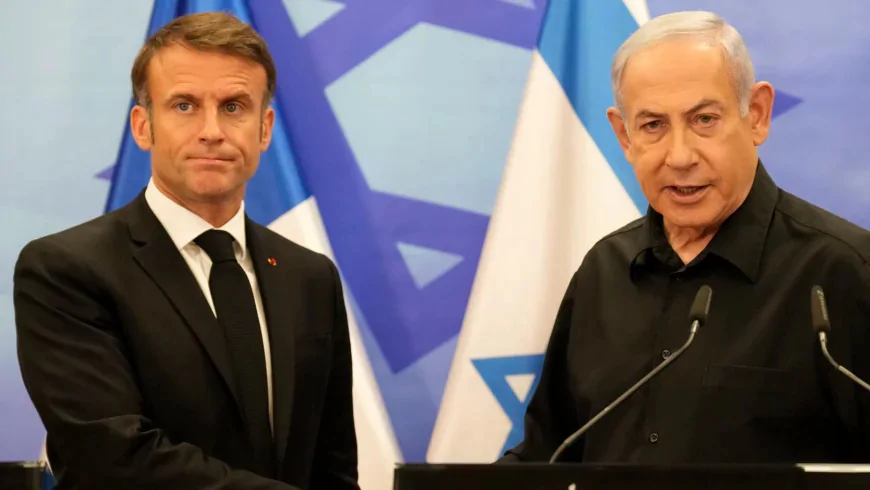
France Breaks Cover: Macron's Lebanon Demand Signals European Fracture With Washington
French President Emmanuel Macron directly called on Israeli Prime Minister Benjamin Netanyahu Wednesday to "refrain from a ground offensive" in Lebanon, according to the Elysée Palace, as Hezbollah resumed rocket fire into northern Israel after four months of relative quiet and Israeli officials signalled readiness to expand operations northward. The French intervention is the most explicit public diplomatic pressure any European leader has applied to Israel since the current escalation began last weekend.
Macron's call came as Israeli military officials briefed journalists that a "broad wave of strikes" was underway in Tehran. After four months in which Israeli shelters had stood empty in the north, Israeli civilians were back underground Wednesday as Hezbollah volleys resumed — a development that military analysts describe as coordinated with Iran's strategic communication rather than a spontaneous act of support.
The French position carries specific weight. Paris has historically maintained diplomatic channels with both Israel and Lebanon's political establishment that Washington has not, and France's deployment of troops in UNIFIL — the UN peacekeeping force in southern Lebanon — gives Macron a direct military stake in any Israeli ground operation. French soldiers have previously faced dangerous proximity to Israeli operations in Lebanon, a fact that informs the stridency of Wednesday's demand.
The Lebanon Question: Why a Ground Offensive Would Reshape the War
Israeli ground operations in Lebanon would represent a qualitative escalation beyond the current air-and-strike campaign and would trigger a set of political consequences that even the current conflict's architects may not have fully calculated. A ground incursion requires sustained forces on foreign soil, creates the conditions for asymmetric guerrilla combat that Hezbollah has demonstrated twice — in 2000 and 2006 — it can sustain, and risks direct contact with UNIFIL personnel from France, Italy, and Spain.
Israeli President Isaac Herzog, speaking to CBS News on Wednesday, was notably restrained. He said he is "not calling on any boots on the ground" in Iran — a statement that addressed the Iran theatre but conspicuously left Lebanon undefined. That ambiguity is precisely what Macron is attempting to close.
According to Dr. Lina Khatib, Director of the Middle East and North Africa Programme at Chatham House, "What Macron is doing is trying to preserve a diplomatic circuit-breaker before Israel makes a unilateral decision that draws European states — particularly through UNIFIL — into a conflict they did not authorise and cannot control. The French call is as much about protecting French soldiers as it is about protecting Lebanon."
European Diplomacy and the Limits of Transatlantic Solidarity
The European Union issued a statement of "utmost concern" on March 1st but has struggled to translate that concern into coordinated political action. EU foreign policy chief Kaja Kallas has held multiple calls with regional counterparts but has not yet convened an emergency foreign ministers session — an absence that reflects the bloc's internal divergence between member states with strong pro-Israeli positions and those, like France and Ireland, demanding more assertive restraint.
The EU Parliament in Brussels adopted a resolution Thursday on the human rights situation in Iran, condemning the targeting of civilian infrastructure and calling for an immediate ceasefire. The resolution passed with a substantial majority but carries no binding force — a reflection of the institutional gap between European normative power and European operational use as use in an active war.
Macron's bilateral call cuts around that institutional slowness. Whether Netanyahu heeds it is a separate question. Israel's prime minister has historically treated European diplomatic pressure as a political variable to be managed rather than a constraint to be respected, and the current US administration's explicit endorsement of Israeli military operations removes the traditional American moderating role from the equation. The real test of France's influence will come if Israeli ground forces cross into Lebanese territory — and what Paris does in response if they do.
The UNIFIL Factor: France's Soldiers and the Ground Offensive Calculus
At the heart of Macron's demand that Israel refrain from a Lebanon ground offensive lies a concrete military reality that has driven French policy on the Lebanese file since 2006: France has approximately 700 soldiers deployed as part of UNIFIL's Land Force Component in southern Lebanon, operating in areas that Israeli ground operations would physically traverse. French officers know from the 2006 war — in which French UNIFIL contingents came under direct fire — that Israeli ground operations in Lebanon do not maintain safe corridors for UN peacekeepers. A 2024 incident in which Israeli fire hit a UNIFIL observation post and injured Spanish and Italian peacekeepers reinvigorated European demands for formal guarantees of peacekeeping safety during Israeli operations.
Any Israeli ground offensive in Lebanon in the current context would place French soldiers — and peacekeepers from Italy, Spain, and a dozen other countries — in a war zone between Israeli forces and Hezbollah. The political consequences for Macron of French military casualties incurred in a war he did not authorise, fighting that his government publicly opposed, would be severe in a domestic political context already defined by the fragility of his governing coalition and the advance of Marine Le Pen's far-right movement.
Israeli President Isaac Herzog's statement that he is "not calling on boots on the ground" in Iran is a partial reassurance. But Lebanon is not Iran, and the political dynamics that drove Israel to expand operations northward in previous conflicts — the pressure to suppress Hezbollah's rocket capacity definitively rather than episodically — have not changed. Whether Herzog's restraint holds, or whether events on the ground produce pressure for a decision that overrides stated preferences, is the question that Macron's Elysée Palace is watching most closely.
What's Your Reaction?
 Like
0
Like
0
 Dislike
0
Dislike
0
 Love
0
Love
0
 Funny
0
Funny
0
 Wow
0
Wow
0
 Sad
0
Sad
0
 Angry
0
Angry
0






Comments (0)