

Sudan War: UAE-Financed RSF Training Camp Exposed Near Ethiopian Border
Reuters revealed a UAE-financed camp near the Ethiopian border training 4,300 RSF fighters, as the UN Security Council sanctioned four RSF commanders for war crimes in Sudan's ongoing civil war.
Key Takeaways
- Reuters revealed a UAE-financed camp near the Ethiopian border training 4,300 RSF fighters, as the UN Security Council sanctioned four RSF commanders for war crimes in Sudan's ongoing civil war.
- Reuters Investigation Exposes Secret UAE Training Camp Fuelling Sudan's Deadliest WarA Reuters investigation published this week revealed the existence of a UAE-financed trainin...
- Published: Mar 04, 2026 — World News


Reuters Investigation Exposes Secret UAE Training Camp Fuelling Sudan's Deadliest War
A Reuters investigation published this week revealed the existence of a UAE-financed training camp near the Ethiopian border that has been preparing 4,300 fighters for Sudan's Rapid Support Forces — the paramilitary group at the centre of one of the world's deadliest and most poorly covered civil conflicts. The disclosure represents the most detailed public documentation yet of the United Arab Emirates' direct military support for the RSF, a relationship the Emirati government has publicly denied or minimized since the war between the RSF and Sudan's national army began in April 2023.
The RSF, led by General Mohamed Hamdan Dagalo — known as Hemeti — was itself born from the Janjaweed militias responsible for atrocities in Darfur in the early 2000s. Since April 2023 it has conducted a campaign of mass killings, systematic sexual violence, and deliberate destruction of civilian infrastructure across Sudan, with the city of El Fasher in North Darfur currently encircled and facing what aid organisations describe as an imminent humanitarian catastrophe. The Reuters investigation adds a specific and named state actor to the chain of accountability for those crimes.
The Ethiopian border location of the camp is geopolitically significant. Ethiopia, already managing the aftermath of its own catastrophic civil war in Tigray — a conflict that officially ended with a 2022 peace agreement but has seen recent clashes reignite — is being used as a staging ground for a proxy military buildup that neither Addis Ababa nor Abu Dhabi has publicly acknowledged. The disclosure complicates Ethiopia's already strained relationships with both Sudan and Eritrea, and raises questions about Prime Minister Abiy Ahmed's government's awareness of and acquiescence to the camp's operation.
UN Security Council Sanctions Four RSF Commanders
Responding to the investigation's findings and mounting international pressure, the UN Security Council this week sanctioned four RSF commanders for war crimes committed during the Sudan conflict. The sanctions — travel bans and asset freezes — represent the council's most direct accountability action against named individuals in the Sudan conflict since the war began nearly three years ago. However, analysts noted that the sanctions list falls far short of the documentation requirements needed to advance cases before the International Criminal Court, and that the UAE's role in financing and equipping the RSF remains outside the sanctions framework.
The RSF has been the subject of ICC preliminary examination for some time, but Sudan is not an ICC member state, requiring a Security Council referral that China and Russia — both of which have economic relationships with Hemeti's network — have blocked. The UAE's deepening documented involvement complicates any future referral diplomacy, as Abu Dhabi has leveraged its strategic importance to Washington and London as protection against diplomatic accountability.
Near-daily drone strikes attributed to Sudan's national army are hitting markets, hospitals, and residential areas in Kordofan, according to UN monitors and local civil society groups. The Quad ceasefire plan — backed by the United States, United Kingdom, Saudi Arabia, and the UAE — was rejected by Sudan's national army (SAF), which accused the framework of implicitly legitimising RSF territorial gains made through violence.
Donors Retreat as Civilian Death Toll Climbs
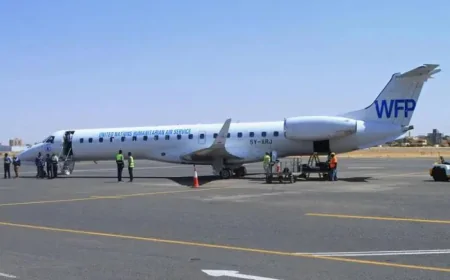
The humanitarian picture inside Sudan has deteriorated sharply over the past 60 days. The World Food Programme estimates that 25 million people — more than half Sudan's pre-war population — are experiencing acute food insecurity. The U.S. aid cuts under the Trump administration have compounded an already overwhelmed aid system: USAID's Sudan operations were among the programmes eliminated when the agency was effectively shuttered in early 2025, and no comparable replacement funding has been identified.
Rebel-accused massacres have continued, with video footage of atrocities circulating on social media platforms and prompting calls for expanded documentation efforts from Human Rights Watch and Amnesty International. The International Criminal Court's existing arrest warrant for former Sudanese President Omar al-Bashir has never been enforced — a precedent that RSF commanders and their foreign backers have noted as evidence that international accountability mechanisms have limited reach.
According to Dr. Suliman Baldo, Senior Advisor at The Sentry, an investigative organisation tracking war crimes in Africa, "The Reuters investigation confirms what human rights monitors have suspected for over a year: the RSF's military capacity to sustain this war at this scale is not indigenous — it is externally financed and externally trained, and the UAE is the primary external actor."
Whether the exposure of the Ethiopian border camp produces any meaningful shift in international policy toward the UAE — a government that is simultaneously hosting Ukraine-Russia peace talks, maintaining strategic partnerships with both the United States and European powers, and financing one of the world's bloodiest conflicts — is a question the Khartoum-based survivors of RSF violence are watching with exhausted attention.
What's Your Reaction?
 Like
0
Like
0
 Dislike
0
Dislike
0
 Love
0
Love
0
 Funny
0
Funny
0
 Wow
0
Wow
0
 Sad
0
Sad
0
 Angry
0
Angry
0







Comments (0)