

Colombia Heads to Sunday Elections With Citizen Security at Stake
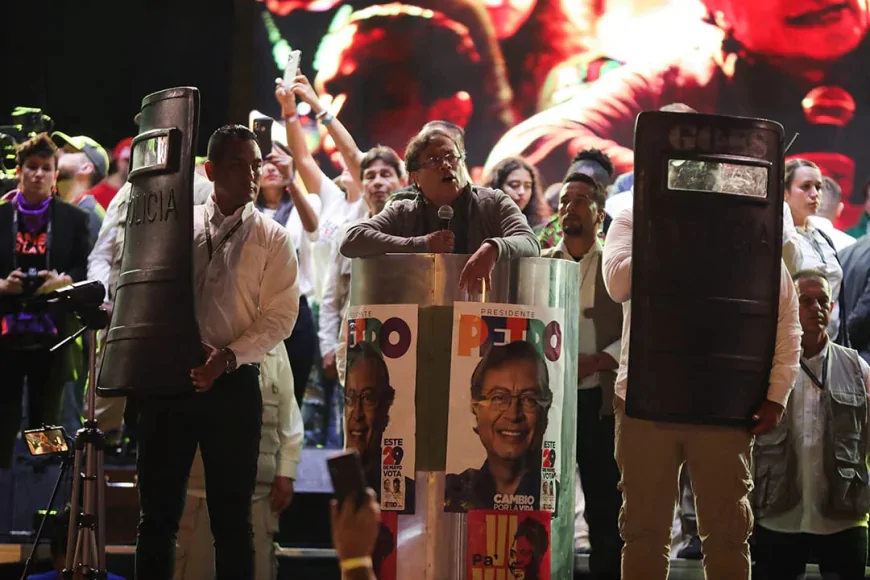
Colombia holds legislative elections Sunday March 8, the first major test of President Petro's governing mandate ahead of the May presidential contest.
Key Takeaways
- Colombia holds legislative elections Sunday March 8, the first major test of President Petro's governing mandate ahead of the May presidential contest.
- Colombia's Legislative Vote Sunday Will Test Petro's Governing Mandate and Set Stage for May Presidential Race Colombia heads to the polls on Sunday for elections to its Senate ...
- Published: Mar 05, 2026 — World News
Colombia's Legislative Vote Sunday Will Test Petro's Governing Mandate and Set Stage for May Presidential Race
Colombia heads to the polls on Sunday for elections to its Senate and Chamber of Representatives — the first major electoral test of President Gustavo Petro's left-wing government, which has governed since August 2022 with a programmatic agenda of social reform and negotiated peace that has collided, with increasing political cost, against the reality of escalating organised crime and slowing economic growth. The outcome of Sunday's vote will shape the congressional composition that any presidential candidate — of any party — will need to build a legislative agenda in the May 31 presidential election that follows.
Petro enters the legislative campaign in a condition of political weakness that his opponents have made central to their campaign messaging. His approval rating has fallen sharply from the optimism of his first year in office, weighed down by the failure of his "Total Peace" strategy — which sought to negotiate simultaneous ceasefires with multiple armed groups including dissident FARC factions, the National Liberation Army (ELN), and criminal organisations — to deliver the security gains his government promised.
Homicides, extortion rates, and displacement figures driven by criminal and political violence have worsened in several departments since Petro took office. His critics, including right-wing presidential frontrunner Miguel Uribe Turbay, argue that the Total Peace approach has strengthened criminal organisations by granting them negotiating legitimacy and operational breathing space while Colombians in affected regions suffer the consequences of unresolved violence.
The Total Peace Policy Under Scrutiny: Evidence and Contested Claims
The empirical record of Total Peace is genuinely contested. In some regions, nationally mediated ceasefires produced measurable reductions in violence; in others, including parts of Caquetá and Putumayo, violence intensified as sub-factions of ostensibly negotiating groups engaged in internal power struggles and territory contests that the ceasefire frameworks failed to contain. The government has pointed to specific success cases; opposition politicians have emphasised the failures with greater political traction.
The ELN peace process — the most advanced of Petro's negotiating tracks — has produced multiple rounds of talks in Cuba, Venezuela, and Mexico but has not produced a stable ceasefire. ELN commanders have repeatedly violated agreed frameworks and continued to carry out attacks on oil infrastructure and civilian populations in regions including Norte de Santander, Arauca, and Chocó. The government has suspended and resumed talks several times, each cycle generating diminishing domestic political returns.
According to Dr. Juan Diego Restrepo, Director of the Conflict Analysis Centre Indepaz in Bogotá, "The fundamental problem with Total Peace as a political project is that it was designed as a peace strategy but is being evaluated as a security strategy. Peace processes take years to produce security results; Colombians are measuring the government's performance on a quarterly crime statistics basis. Petro conflated those two timelines publicly, and he is paying a political price for that conflation."
The Legislative Stakes and the Road to May
Sunday's legislative election will determine the congressional blocs that shape the May presidential contest's governability calculus. A strong showing by right and centre-right parties — Cambio Radical, the Democratic Centre, and the Conservative Party — would signal that Petro's movement, the Pacto Histórico coalition, faces a hostile congress for any successor from his political family. A more fragmented result, which polling suggests is likely, would produce the kind of parliamentary arithmetic that makes governing difficult regardless of presidential ideology.
The presidential race, scheduled for a first round on May 31 and a runoff on June 21, features a crowded field. Miguel Uribe Turbay, running on a security-first platform that explicitly channels the legacy of former President Álvaro Uribe without the elder Uribe's most polarising elements, leads early polling. Former Mayor of Medellín Daniel Quintero and former Vice President Francia Márquez are among those exploring candidacies from the left. The centre is occupied by figures attempting to capture the exhaustion with polarisation that Colombian polling consistently identifies as the dominant voter sentiment.
What Sunday's result cannot resolve is the deeper question that Colombia has faced across its entire democratic history: whether a state that has never achieved a monopoly on legitimate violence can build the political consensus necessary for stable democratic governance. That question is as live in 2026 as it was in 2002.
The Petro Agenda on Trial: What the March 8 Result Will Actually Show
Sunday's legislative election is not only a test of public confidence in President Petro; it is a referendum on the viability of his entire programmatic agenda. The Pacto Histórico coalition that brought Petro to power in 2022 was itself an unusual assemblage of left-wing movements, progressive civil society groups, and regional political machines that had never before operated as a unified electoral force. Holding that coalition together through four years of governance — including the disappointments of the Total Peace policy, the friction with a congress that has been difficult to manage, and the economic slowdown that has reduced fiscal space for social programmes — has proven harder than the coalition's architects anticipated.
The agrarian reform agenda, perhaps the most historically significant element of Petro's programmatic commitments, has advanced more slowly than the government promised. The health system reform, which sought to transform the structure of Colombia's privatised health sector, generated intense opposition from the private insurance industry and stalled in congressional committees. The labour reform, designed to extend formal employment protections to Colombia's large informal workforce, has similarly faced congressional resistance. The structural reforms that Petro's base regards as the core justification for his government are, two-thirds through his term, largely unrealised.
Whether Sunday's result produces a congress more or less amenable to those reforms — or whether it produces a congress focused primarily on the presidential election and positioning for the post-Petro era — will tell observers something essential about where Colombian politics is heading. The legislative election is the prologue; May 31 is the chapter that will actually determine the country's course for the next four years.
What's Your Reaction?
 Like
0
Like
0
 Dislike
0
Dislike
0
 Love
0
Love
0
 Funny
0
Funny
0
 Wow
0
Wow
0
 Sad
0
Sad
0
 Angry
0
Angry
0






Comments (0)